

Real ISO-9001-Lead-Auditor are Uploaded by ITPassLeader provide 2026 Latest ISO-9001-Lead-Auditor Practice Tests Dumps.
All ISO-9001-Lead-Auditor Dumps and QMS ISO 9001:2015 Lead Auditor Exam Training Courses Help candidates to study and pass the QMS ISO 9001:2015 Lead Auditor Exam Exams hassle-free!
NEW QUESTION # 107
Scenario 5: Mechanical-Electro (ME) Audit Stages
Mechanical-Electro, better known as ME, is an American company that provides mechanical and electrical services in China. Their services range from air-conditioning systems, ventilation systems, plumbing, to installation of electrical equipment in automobile plants, electronic manufacturing facilities, and food processing plants.
Due to the fierce competition from local Chinese companies and failing to meet customer requirements, ME's revenue dropped significantly. In addition, customers' trust and confidence in the company decreased, and the reputation of the company was damaged.
In light of these developments, the top management of ME decided to implement a quality management system (QMS) based on ISO 9001. After having an effective QMS in place for over a year, they applied for a certification audit.
A team of four auditors was appointed for the audit, including Li Na as the audit team leader. Initially, the audit team conducted a general review of ME's documents, including the quality policy, operational procedures, inventory lists, QMS scope, process documentation, training records, and previous audit reports.
Li Na stated that this would allow the team to maintain a systematic and structured approach to gathering documents for all audit stages. While reviewing the documented information, the team observed some minor issues but did not identify any major nonconformities. Therefore, Li Na claimed that it was not necessary to prepare a report or conduct a meeting with ME's representatives at that stage of the audit. She stated that all areas of concern would be discussed in the next phase of the audit.
Following the on-site activities and the opening meeting with ME's top management, the audit team structured an audit test plan to verify whether ME's QMS conformed to Clause 8.2.1 (Customer Communication) of ISO
9001.
To do so, they gathered information through group interviews and sampling. Li Na conducted interviews with departmental managers in the first group and then with top management. In addition, she chose a sampling method that sufficiently represented customer complaints from both areas of ME's operations.
The team members were responsible for the sampling procedure. They selected a sample size of 4 out of 45 customer complaints received weekly for electrical services and 2 out of 10 complaints for mechanical services.
Afterward, the audit team evaluated the evidence against the audit criteria and generated the audit findings.
Which stages of the audit were performed?
- A. Audit follow-up and stage 1 audit.
- B. Stage 2 audit and surveillance audit.
- C. Stage 1 and stage 2 audit.
Answer: C
Explanation:
Comprehensive and Detailed In-Depth Explanation:
Understanding Audit Stages Based on ISO/IEC 17021-1:2015
ISO certification audits consist of two main stages:
Stage 1 Audit (Readiness Review)
The organization's documented information is reviewed to assess readiness for Stage 2.
This ensures that the QMS is developed, implemented, and prepared for full assessment.
Stage 2 Audit (On-Site Evaluation)
Auditors assess process implementation and effectiveness through interviews, observations, and evidence collection.
The audit team verifies if the organization meets ISO 9001 requirements in practice.
Why is the Correct Answer B?
The audit team reviewed ME's documents, which is a Stage 1 activity.
The audit team performed interviews, sampling, and on-site verification, which is a Stage 2 activity.
There was no mention of an audit follow-up or a surveillance audit, which occur post-certification.
Why are the Other Options Incorrect?
A (Audit follow-up and Stage 1 Audit) # Follow-up audits occur after certification, which was not the case here.
C (Stage 2 Audit and Surveillance Audit) # Surveillance audits are post-certification audits and were not conducted yet.
Reference:
ISO/IEC 17021-1:2015, Clause 9.3.1 - Initial Certification Audit (Stage 1 & 2)
NEW QUESTION # 108
Scenario 4:
TD Advertising is a print management company based in Chicago. The company offers design services, digital printing, storage, and distribution. As TD expanded, its management recognized that success depended on adopting new technologies and improving quality.
To ensure customer satisfaction and quality improvement, the company decided to pursue ISO 9001 certification.
After implementing the QMS, TD hired a well-known certification body for an audit. Anne Key was appointed as the audit team leader. She received a document listing the audit team members, audit scope, criteria, duration, and audit engagement limits.
Anne reviewed the document and approved the audit mandate. The certification body and TD's top management signed the certification agreement.
Before contacting TD, Anne reviewed the audit scope and noticed that TD made changes to it due to the adoption of new printing equipment. However, Anne disagreed with the changes, stating they would affect the audit timeline. She considered withdrawing from the audit.
Based on scenario 4, conducting which of the activities below is NOT the responsibility of Anne?
- A. Signing the certification agreement.
- B. Assigning responsibilities for the audit team members.
- C. Determining the audit feasibility.
- D. Establishing audit criteria and objectives.
Answer: A
Explanation:
Comprehensive and Detailed In-Depth Explanation:
ISO 9001:2015 requires specific roles and responsibilities for audit leaders and certification bodies.
Clause References:
* ISO 19011:2018, Clause 5.5 - Conducting the Audit: Defines audit team leader responsibilities.
* ISO/IEC 17021-1:2015, Clause 9.1.2 - Audit Planning: Defines certification body responsibilities, including the certification agreement.
Why is the Correct Answer D?
* The certification agreement is signed between the certification body and the auditee (TD Advertising).
* Anne (audit team leader) does NOT have authority to sign the agreement-that is the responsibility of the certification body's management.
Why are the Other Options Incorrect?
* A (Establishing audit criteria and objectives) # Correct responsibility of the audit leader as per ISO 19011.
* B (Determining audit feasibility) # Audit leaders assess feasibility but do not sign agreements.
* C (Assigning responsibilities for the audit team) # This is part of the audit leader's role in planning audits.
Reference:
ISO 19011:2018, Clause 5.5 - Conducting the Audit
ISO/IEC 17021-1:2015, Clause 9.1.2 - Audit Planning
NEW QUESTION # 109
The following list gives examples of records that may be evidence of how an organisation has fulfilled the requirements of clause 8.4 of ISO 9001. Match the records to the appropriate requirement of clause 8.4.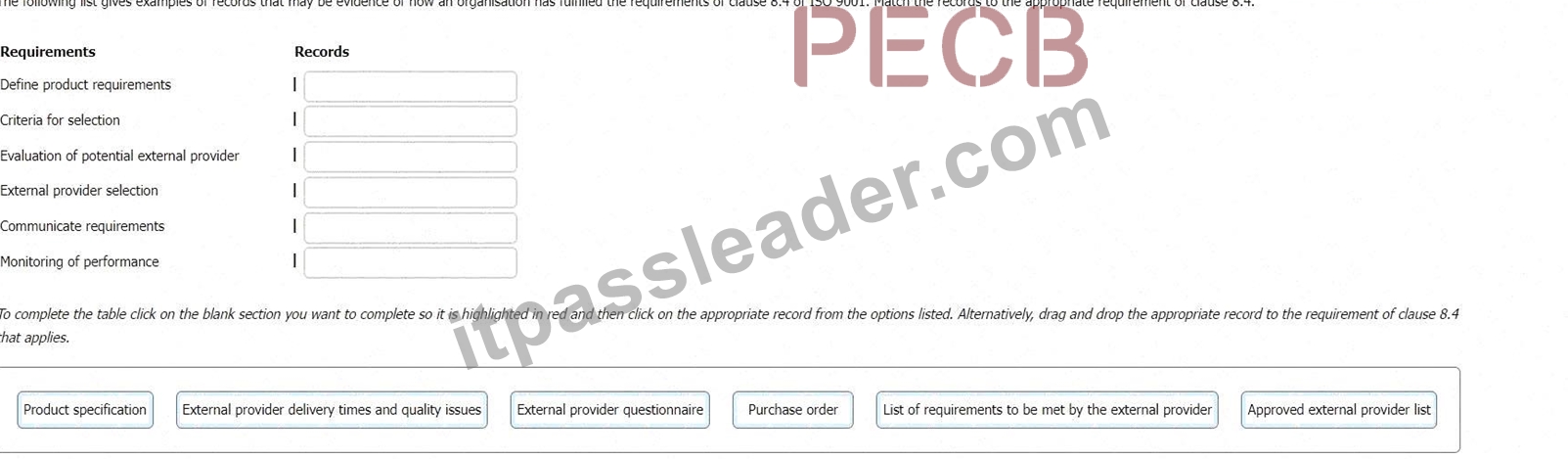
Answer:
Explanation: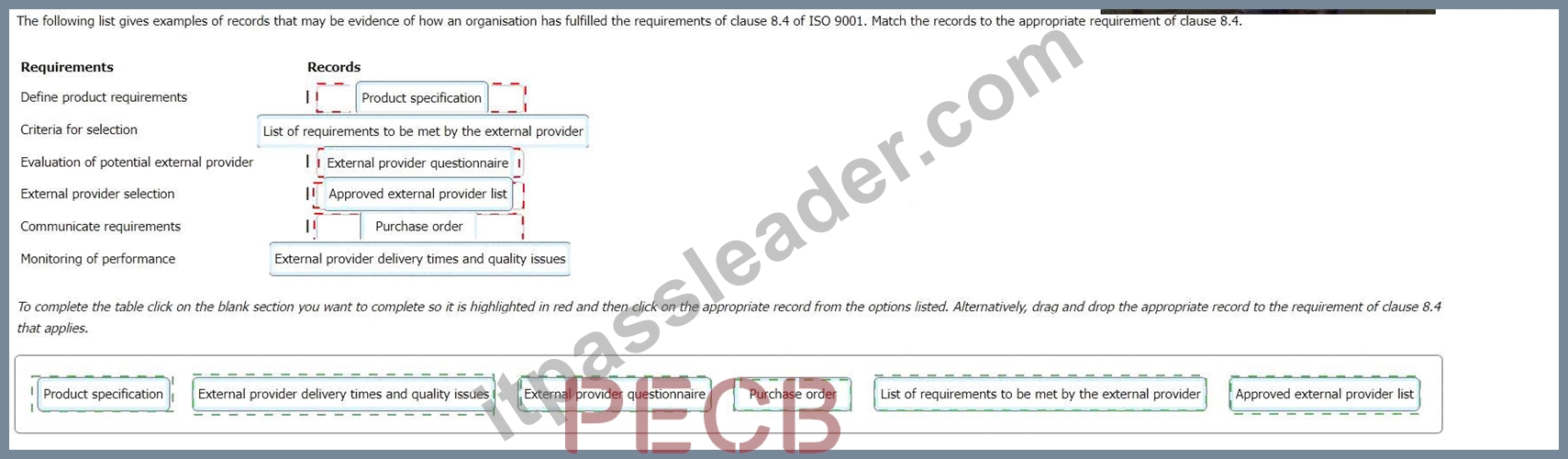
Explanation: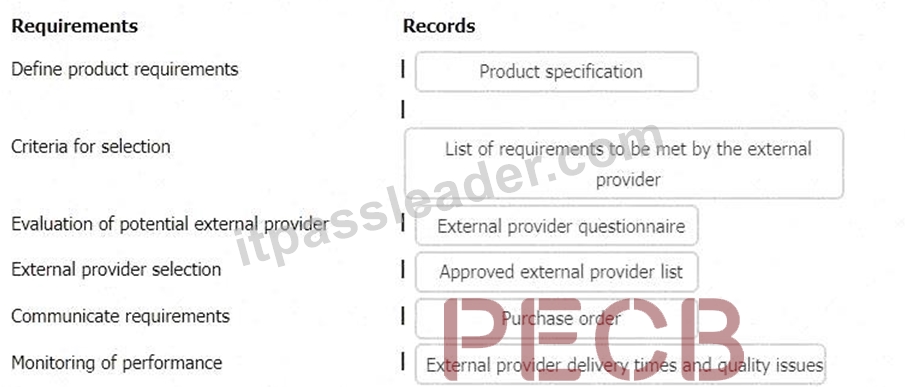
The following table shows the possible matching of the records to the requirements of clause 8.4:
Table
Requirements
Records
Define product requirements
Product specification
Criteria for selection
List of requirements to be met by the external provider
Evaluation of potential external provider
External provider questionnaire
External provider selection
Approved external provider list
Communicate requirements
Purchase order
Monitoring of performance
External provider delivery times and quality issues
Comprehensive and Detailed Explanation: = According to clause 8.4 of ISO 9001:2015, the organization should ensure that externally provided processes, products, and services conform to the specified requirements. To do so, the organization should:
Define the product requirements that are relevant for the external provision, such as specifications, drawings, standards, codes, etc. These should be documented and communicated to the external provider. A record of the product specification can be used as evidence of this requirement.
Establish the criteria for the selection, evaluation, and re-evaluation of external providers, based on their ability to provide processes, products, and services in accordance with the requirements. The criteria should be documented and applied consistently. A record of the list of requirements to be met by the external provider can be used as evidence of this requirement.
Evaluate the potential external providers before selecting them, using the established criteria. The evaluation methods may include questionnaires, audits, references, samples, etc. The results of the evaluation should be documented and reviewed. A record of the external provider questionnaire can be used as evidence of this requirement.
Select the external providers that have demonstrated their competence and conformity to the requirements.
The selection should be based on the evaluation results and the organization's needs. The selection should be documented and approved. A record of the approved external provider list can be used as evidence of this requirement.
Communicate the requirements for the processes, products, and services to be provided by the external provider, including the verification and validation activities, the acceptance criteria, the documentation requirements, the changes control, etc. The communication methods may include purchase orders, contracts, agreements, etc. The communication should be clear, complete, and timely. A record of the purchase order can be used as evidence of this requirement.
Monitor the performance and conformity of the external provider, using the established criteria and methods.
The monitoring methods may include inspections, tests, audits, feedback, complaints, etc. The monitoring results should be documented and analyzed. A record of the external provider delivery times and quality issues can be used as evidence of this requirement.
References: ISO 9001:2015, [ISO 9001 Auditing Practices Group Guidance on Scope], Mastering the Scope of ISO 9001 Quality Management Systems
NEW QUESTION # 110
XYZ Corporation is an organisation that employs 100 people. As audit team leader, you are conducting a certification audit at Stage 1. When reviewing the quality management system (QMS) documentation, you find that quality objectives have been set for every employee in the organisation except top management.
The Quality Manager complains that this has created a lot of resistance to the QMS, and the Chief Executive is asking questions about how much it will cost. He asks for your opinion on whether this is the correct method of setting objectives.
Three months after Stage 1, you return to XYZ Corporation to conduct a Stage 2 certification audit as Audit Team Leader with one other auditor. You find that the Quality Manager has cancelled the previous quality objectives for all employees and replaced them with a single objective for himself. This states that "The Quality Manager will drive multiple improvements in the QMS in the next year". The Quality Manager indicates that this gives him the authority to issue instructions to department managers when quality improvement is needed. He says that this approach has the full backing of senior management. He shows you the latest Quality Improvement Request that was included in the last management review.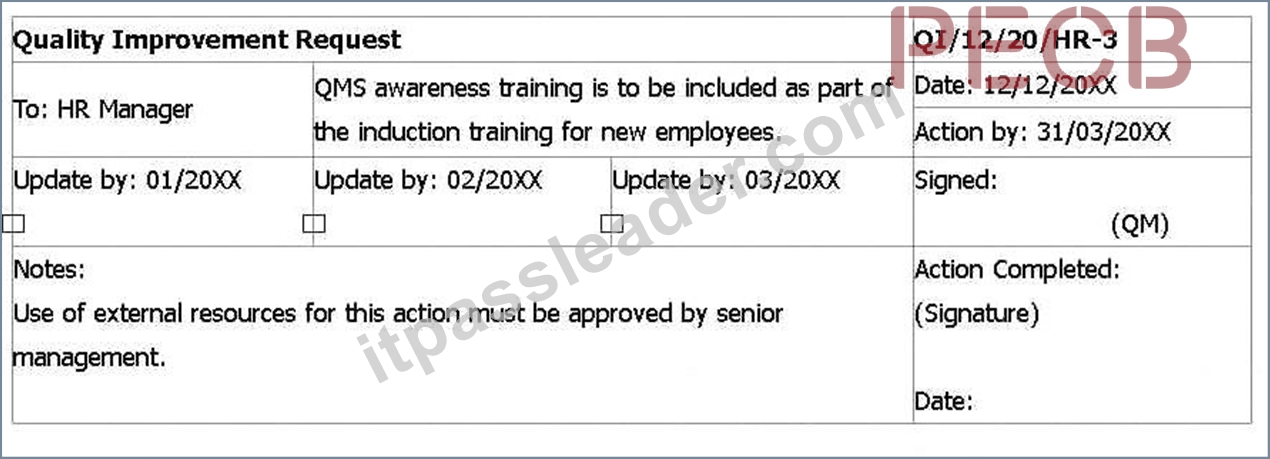
After further auditing, the issues below were found. Select three statements that apply to the term 'audit trail'
- A. Quality improvements not aligning with the quality policy.
- B. Decisions on improvement action timescales not involving departmental managers.
- C. The single quality objective set for the organisation by the Quality Manager.
- D. Evaluation of the results of the improvement action not always documented by the Quality Manager.
- E. Limited knowledge of the content of Quality Improvement Requests by departmental staff.
- F. Top management claim not to be aware of the improvement request (QI/12/20/HR-3) initiated by the Quality Manager.
Answer: B,D,E
Explanation:
Based on the scenario and the concept of an 'audit trail' within the context of ISO 9001, the three statements that apply would likely be:
A: Decisions on improvement action timescales not involving departmental managers. This indicates a lack of involvement and communication with those responsible for implementing the improvements, which is a key part of an effective audit trail1.
B: Evaluation of the results of the improvement action not always documented by the Quality Manager.
Proper documentation is essential for an audit trail, as it provides evidence that actions have been evaluated and are effective1.
C: Limited knowledge of the content of Quality Improvement Requests by departmental staff. An audit trail should ensure that all relevant parties are aware of and understand the actions being taken, which is not the case here1.
These points suggest issues with the communication, documentation, and involvement of relevant personnel in the quality management system processes, which are crucial for maintaining an effective audit trail and, by extension, a robust quality management system.
NEW QUESTION # 111
Select six tasks you would expect to be completed at the audit team meeting of a third-party audit team leader and his audit team in preparation for a Closing meeting for a four-day initial certification audit.
- A. Audit team leader informs the individual(s) managing the audit programme that the closing meeting is ready to be held.
- B. Hold daily audit team meeting to review any timetable issues and potential findings and their impact on the audit for other team members.
- C. Re-audit corrective actions taken to correct findings found during the audit.
- D. Audit team review any points raised by the auditee nominated representative.
- E. Audit team leader completes final report, including individual findings and certification recommendation.
- F. Audit team complete final version of their individual findings.
- G. Write the audit finding report out when detected and obtain signature of the auditee.
- H. Final audit team meeting to agree findings and categories including clarification of any uncertainties.
- I. Agree the roles of each audit team member for the closing meeting.
- J. Audit team agree final audit outcome recommendation.
Answer: C,D,F,H,I,J
Explanation:
The tasks that are expected to be completed at the audit team meeting of a third-party audit team leader and his audit team in preparation for a Closing meeting for a four-day initial certification audit are:
*Option C: Final audit team meeting to agree findings and categories including clarification of any uncertainties. This option is correct because the audit team meeting is an opportunity for the audit team leader and the audit team members to review and consolidate the audit findings, to ensure that they are clear, accurate, objective, and supported by sufficient audit evidence. The audit team should also agree on the categories of the findings, such as nonconformity, observation, or opportunity for improvement, and resolve any uncertainties or disagreements among the audit team members.
*Option D: Agree the roles of each audit team member for the closing meeting. This option is correct because the audit team meeting is an opportunity for the audit team leader to assign the roles and responsibilities of each audit team member for the closing meeting, such as presenting the audit findings, answering questions, or taking notes. The audit team leader should also ensure that the audit team members are prepared and confident to perform their roles and to communicate effectively with the auditee.
*Option E: Audit team review any points raised by the auditee nominated representative. This option is correct because the audit team meeting is an opportunity for the audit team to review any points raised by the auditee nominated representative during the audit, such as requests for clarification, feedback, or complaints. The audit team should consider the validity and relevance of the points raised and decide how to address them in the closing meeting or in the audit report.
*Option F: Audit team agree final audit outcome recommendation. This option is correct because the audit team meeting is an opportunity for the audit team to agree on the final audit outcome recommendation, based on the audit findings and the audit criteria. The audit team should also consider the implications and consequences of the audit outcome recommendation for the auditee and the certification body, and ensure that the recommendation is consistent and justified.
*Option H: Audit team complete final version of their individual findings. This option is correct because the audit team meeting is an opportunity for the audit team to complete the final version of their individual findings, based on the agreement and feedback from the audit team meeting. The audit team should ensure that their individual findings are written in a clear, concise, and factual manner, and that they include the audit criteria, the audit evidence, and the audit conclusion. The audit team should also submit their individual findings to the audit team leader for review and approval.
*Option I: Re-audit corrective actions taken to correct findings found during the audit. This option is correct because the audit team meeting is an opportunity for the audit team to re-audit the corrective actions taken by the auditee to correct the findings found during the audit, if applicable and feasible. The audit team should verify the effectiveness and adequacy of the corrective actions and update the audit findings accordingly. The audit team should also document the results of the re-audit and communicate them to the auditee.
The following options are not correct:
*Option A: Audit team leader informs the individual(s) managing the audit programme that the closing meeting is ready to be held. This option is not correct because this task is not part of the audit team meeting, but part of the communication between the audit team leader and the individual(s) managing the audit programme. The audit team leader should inform the individual(s) managing the audit programme that the closing meeting is ready to be held after the audit team meeting, when the audit team has completed all the tasks and is ready to present the audit results to the auditee.
*Option B: Hold daily audit team meeting to review any timetable issues and potential findings and their impact on the audit for other team members. This option is not correct because this task is not part of the final audit team meeting, but part of the daily audit team meetings that are held during the audit. The daily audit team meetings are opportunities for the audit team to review the progress and performance of the audit, to identify and resolve any issues or problems, and to coordinate and adjust the audit plan and activities as needed.
*Option G: Audit team leader completes final report, including individual findings and certification recommendation. This option is not correct because this task is not part of the audit team meeting, but part of the audit reporting process. The audit team leader should complete the final report, including the individual findings and the certification recommendation, after the closing meeting, when the audit team has received and considered the feedback and comments from the auditee. The audit team leader should also ensure that the final report is reviewed and approved by the appropriate authorities before issuing it to the auditee and the certification body.
*Option J: Write the audit finding report out when detected and obtain signature of the auditee. This option is not correct because this task is not part of the audit team meeting, but part of the audit evidence collection and documentation process. The audit team should write the audit finding report out when detected and obtain the signature of the auditee during the audit, when the audit team has observed and verified the audit evidence and has communicated the audit finding to the auditee. The signature of the auditee does not indicate acceptance or agreement with the audit finding, but only acknowledgement of receipt.
References:
*ISO 19011:2018 Guidelines for auditing management systems, Clause 6.4.2: Conducting audit activities, Subclause i) and j)
*ISO 9001 Lead Auditor Course Material, Module 5: Conducting an Audit, Slide 19: Audit Team Meeting
*ISO 9001 Lead Auditor Training Course - IRCA Certified, Section 5.4: Audit Team Meeting
*Lead Auditor Exam Preparation Guide (EPG) Template - PECB, Section 3.2: Exam Content Outline, Subsection 3.2.1: Section 1 - Audit Fundamentals, Subsection 3.2.2: Section 2 - Audit Principles, Subsection
3.2.3: Section 3 - Audit Process, Subsection 3.2.4: Section 4 - Audit Competencies
NEW QUESTION # 112
Scenario 2:
Bell is a Canadian food manufacturing company that operates globally. Their main products include nuts, dried fruits, and confections. Bell has always prioritized product quality and has maintained a good reputation for many years. However, the company's production error rate increased significantly, leading to more customer complaints.
To increase efficiency and customer satisfaction, Bell implemented a Quality Management System (QMS) based on ISO 9001. The top management established a QMS implementation team comprising five middle managers from various departments, including Leslie, the quality manager.
Leslie was responsible for assigning responsibilities and authorities for QMS-related roles. He also suggested including a top management representative in the QMS team, but top management declined due to other priorities.
The team defined the QMS scope as:
"The scope of the QMS includes all activities related to food processing." Leslie established a quality policy and presented it to the team for review before top management approval
. Top management also proposed a new strategy for handling customer complaints, requiring biweekly customer surveys to monitor customer perceptions.
Which statement related to the last paragraph of scenario 2 is correct?
- A. Customer surveys should be conducted every week to have a clear understanding of the needs and expectations of customers.
- B. Top management demonstrated leadership and commitment with respect to customer satisfaction.
- C. Customer surveys are the best method for obtaining and monitoring customer perceptions.
- D. Customer satisfaction is only measured through complaints, making surveys unnecessary.
Answer: B
Explanation:
Comprehensive and Detailed In-Depth Explanation:
ISO 9001:2015, Clause 5.1.2 (Customer Focus) states that top management must ensure customer satisfaction by monitoring customer perceptions.
In scenario 2, top management initiated customer surveys, demonstrating their commitment to customer focus as required by Clause 5.1.2.
Reference:
ISO 9001:2015, Clause 5.1.2 - Customer Focus
NEW QUESTION # 113
Noitol is an organisation specialising in the design and production of e-learning training materials for the insurance market. During an ISO 9001 audit of the development department, the auditor asks the Head of Development about the process used for validation of the final course design. She states that they usually ask customers to validate the product with volunteers. She says that the feedback received often leads to key improvements.
The auditor samples the design records for a recently completed course for the 247 Insurance organisation.
Design verification was carried out but there was no validation report. The Head of Development advises that this customer required the product on an urgent basis, so the validation stage was omitted. When asked, the Head estimates that this occurs about 50% of the time. She confirms that they always ask for feedback and often make changes. There is no record of feedback in the design file for the course.
The auditor raises a nonconformity against ISO 9001. Which one of the following options is the basis for the nonconformity?
- A. 8.3.5 - The improvements made to course designs are not documented. Feedback from customers is not always actioned.
- B. 8.3.2.c - Design planning does not include design validation. Design verification is part of the planning process.
- C. 8.6 - Course materials are released without proper approval. A course for 247 Insurance was released on an urgent basis.
- D. 8.3.4.d - Design validation is not always conducted. It is omitted about half of the time.
Answer: D
Explanation:
Clause 8.3.4.d of ISO 9001:2015 requires that design and development validation be performed to ensure that the resulting products or services meet the requirements for their specified application or intended use.
Validation is critical to confirm that the product works as intended in real-world conditions.
In this case, Noitol omitted the design validation step approximately 50% of the time, which is a direct violation of Clause 8.3.4.d. Although they collect feedback after the fact, this is not a substitute for formal validation before the product is released. The nonconformity arises because the process of validation was neglected, not the recording of improvements or feedback.
Other options, such as documenting improvements (A) or issues with planning verification (B), are important but do not directly address the primary concern: the lack of consistent design validation before product release. Option D (8.6) concerns product release, but this nonconformity focuses on the validation stage, not just approval for release.
NEW QUESTION # 114
Scenario 3:
Fin-Pro is a financial institution in Austria offering commercial banking, wealth management, and investment services. The company faced a significant loss of customers due to failing to improve service quality as they expanded.
To regain customer confidence, top management implemented a QMS based on ISO 9001. After a year, they contacted ACB, a local certification body, to pursue ISO 9001 certification.
The audit team was led by Emilia, an experienced lead auditor, and included three auditors. After an agreement was reached, ACB sent the audit objectives to the audit team.
The audit team began by gathering information about Fin-Pro's understanding of ISO 9001 requirements.
While reviewing documented information, they noticed missing records of training and awareness sessions.
They conducted employee interviews to verify attendance.
The team also reviewed the organizational chart and job descriptions to confirm employee competence. They observed the company's working environment (social, psychological, and physical conditions).
The audit team analyzed the evidence and prepared an audit report with findings and conclusions.
What type of evidence has been collected by the ACB's audit team, as presented in scenario 3?
- A. Observational, secondary, qualitative.
- B. Documentary, confirmative, verbal.
- C. Physical, verbal, analytical.
- D. Verbal, documentary, physical.
Answer: D
Explanation:
Comprehensive and Detailed In-Depth Explanation:
Audit evidence includes information collected through different methods to assess compliance with ISO 9001:
2015 requirements.
Clause References:
ISO 19011:2018, Clause 6.4.6 - Audit Evidence: Audit evidence must be objective, verifiable, and based on facts.
ISO 9001:2015, Clause 9.1.1 - Monitoring, Measurement, Analysis, and Evaluation: Requires organizations to collect and analyze data from multiple sources to verify effectiveness.
Types of Audit Evidence Collected in Scenario 3:
Verbal Evidence - Employee interviews regarding training and awareness sessions.
Documentary Evidence - Organizational charts, job descriptions, training records.
Physical Evidence - Workplace observations to assess working conditions.
Why is the Correct Answer B?
The audit team used a combination of verbal (interviews), documentary (records), and physical (site observations) evidence.
This triangulation approach enhances audit reliability and ensures compliance verification.
Why are the Other Options Incorrect?
A (Confirmative evidence) # Not a formal audit term in ISO 9001 or ISO 19011.
C (Analytical evidence) # Incorrect, as analysis was not a primary method used.
D (Qualitative evidence only) # Incorrect because the audit involved both qualitative (interviews) and quantitative (documents, physical) evidence.
Reference:
ISO 19011:2018, Clause 6.4.6 - Audit Evidence
ISO 9001:2015, Clause 9.1.1 - Monitoring, Measurement, Analysis, and Evaluation
NEW QUESTION # 115
Whistiekleen is a national dry cleaning and laundry organisation with 50 shops. You are conducting a surveillance audit of the Head Office and are sampling customer complaints. You find that 80% of complaints originate from five shops in the same region. Most of these complaints relate to damage to customer laundry.
The Quality Manager tells you that these are the oldest shops in the organisation. The deaning equipment needs replacing but the organisation cannot afford it now. You learn that the shop managers were told to dismiss most of the claims based on the poor quality of the laundered materials.
On raising the matter with senior management, you are told that there are plans to replace the equipment in these shops over the next five years.
Match the ISO 9001 Clauses to the statements.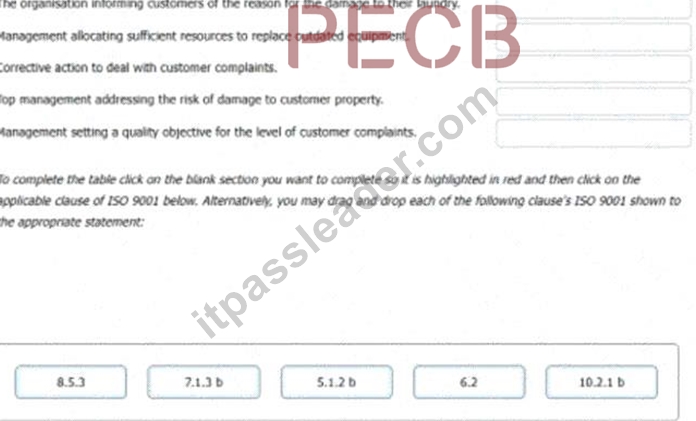
Answer:
Explanation: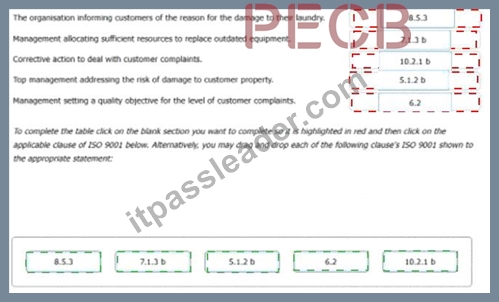
Explanation:
A screenshot of a computer AI-generated content may be incorrect.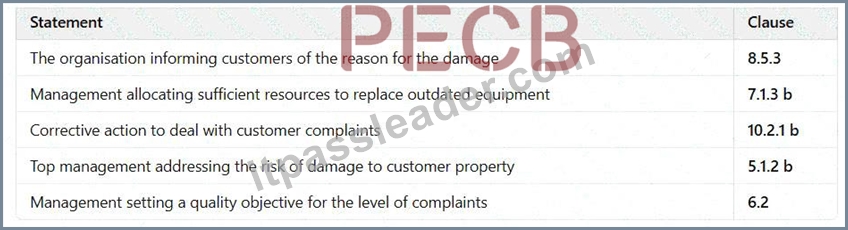
* Clause 8.5.3 - Property Belonging to Customers or External Providers:This clause requires the organization to care for customer property while it is under their control. If there is damage, they must inform the customer and retain documented information. Thus, informing customers of the reason for laundry damage relates directly to this clause.# Reference: ISO 9001:2015 Clause 8.5.3
* Clause 7.1.3 b - Infrastructure:It refers to the provision and maintenance of infrastructure necessary for the operation of processes. This includes equipment. If resources are not allocated for outdated equipment, it directly breaches this clause.# Reference: ISO 9001:2015 Clause 7.1.3 b
* Clause 10.2.1 b - Corrective Action:This clause covers actions to eliminate the causes of nonconformities to prevent recurrence, including evaluating and correcting customer complaints.# Reference: ISO 9001:2015 Clause 10.2.1 b
* Clause 5.1.2 b - Customer Focus (Top Management):Top management must ensure risks to customer satisfaction, including property damage, are addressed. This aligns with addressing the risk of damaging customer laundry.# Reference: ISO 9001:2015 Clause 5.1.2 b
* Clause 6.2 - Quality Objectives and Planning to Achieve Them:Setting objectives for reducing customer complaints (like those about laundry damage) falls under this clause.# Reference: ISO 9001:
2015 Clause 6.2
NEW QUESTION # 116
An organisation decides to purchase products and services only from ISO 9001 certified suppliers.
Match the four organisational functions to a potential benefit.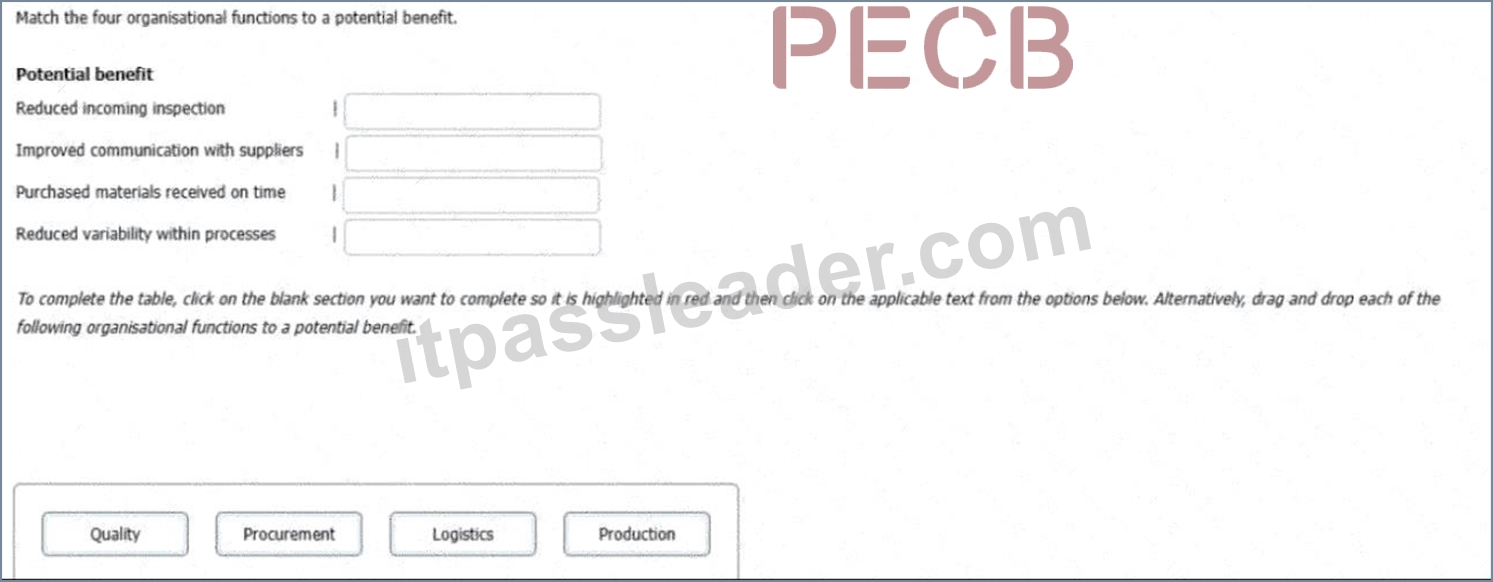
Answer:
Explanation: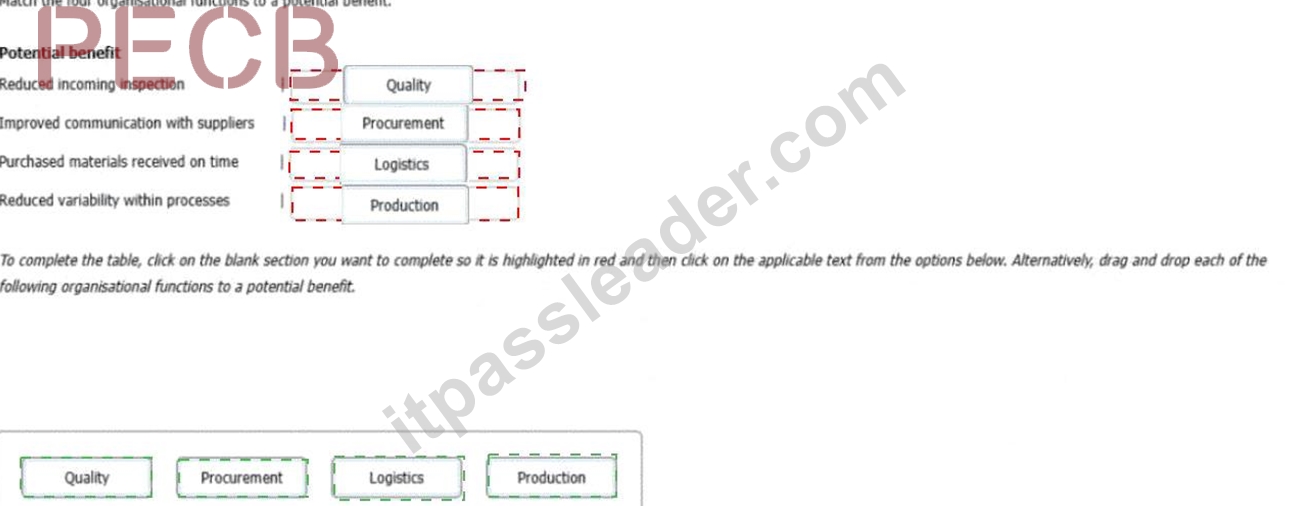
Explanation:
Reduced incoming inspection # A. Quality
Improved communication with suppliers # B. Procurement
Purchased materials received on time # C. Logistics
Reduced variability within processes # D. Production
According to ISO 9001:2015, Clause 8.4 - Control of externally provided processes, products and services, organisations are required to ensure that externally provided products and services conform to specified requirements. When an organisation sources from ISO 9001 certified suppliers, there is greater assurance of consistency in quality, delivery, and communication. This enhances internal operations across various functions:
* Reduced incoming inspection (Quality): ISO 9001 certified suppliers have robust quality controls (Clause 8.4.2), reducing the need for repeated inspections upon receipt. This aligns with Quality's responsibility for incoming inspection and verification.
* Improved communication with suppliers (Procurement): Clause 8.4.3 emphasizes the communication of detailed requirements to external providers. Procurement plays a key role in ensuring these requirements are understood and met.
* Purchased materials received on time (Logistics): Timely deliveries are often a result of structured supplier evaluation and selection (Clause 8.4.1). Logistics benefits through fewer delays and better scheduling of internal processes.
* Reduced variability within processes (Production): Consistency of supplied materials supports stable and predictable production processes, which is a key aspect of Clause 8.5 - Production and service provision.
References:
ISO 9001:2015 Clause 8.4.1 - General
ISO 9001:2015 Clause 8.4.2 - Type and extent of control
ISO 9001:2015 Clause 8.4.3 - Information for external providers
ISO 9001:2015 Clause 8.5 - Production and service provision
NEW QUESTION # 117
Which of the following is a principle of maintaining audit work documents?
- A. Completeness
- B. Fair presentation
- C. Transparency
Answer: A
Explanation:
Comprehensive and Detailed In-Depth Explanation:
Completeness ensures that all necessary audit evidence, observations, and findings are properly documented, which is critical for traceability and accountability in an audit.
While transparency and fair presentation are principles of auditing, completeness is specifically related to maintaining audit work documents, as required in ISO 19011:2018, Clause 6.5.4 (Preparing Audit Work Documents).
Reference:
ISO 19011:2018, Clause 6.5.4 (Preparing Audit Work Documents)
NEW QUESTION # 118
You are conducting an audit at a single-site organisation seeking certification to ISO 9001 for the first time.
The organisation manufactures cosmetics for major retailers and the name of the retailer supplied appears on the product packaging. Sales turnover has increased significantly over the past five years You are interviewing the new Product Development Manager. You note that a software application called SWIFT is used to help control the product development process.
You have gathered audit evidence as outlined in the table. Match the ISO 9001 clause 8.3 extracts to the audit evidence.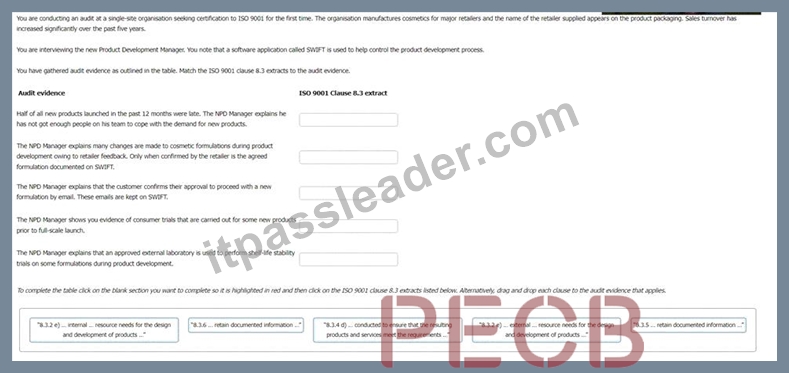
Answer:
Explanation: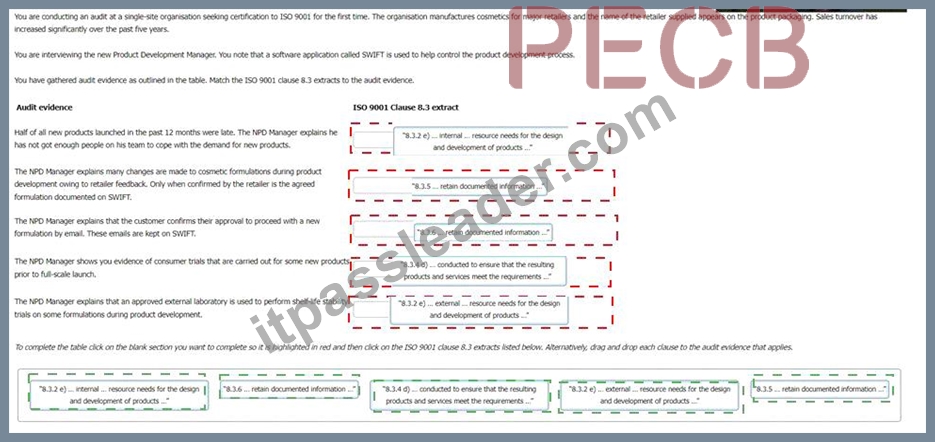
Explanation: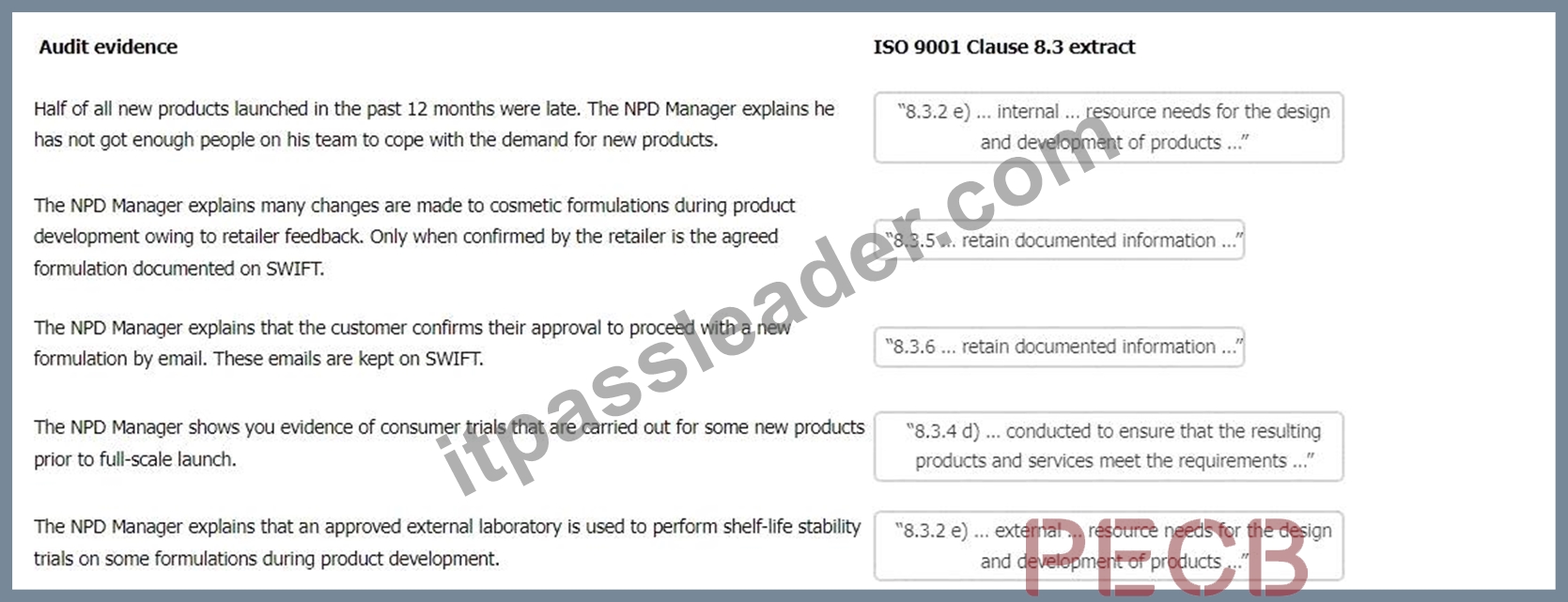
The table below shows the possible matching of the ISO 9001 Clause 8.3 extract to the audit evidence.
Table
Audit evidence
ISO 9001 Clause 8.3 extract
Half of all new products launched in the past 12 months were late. The NPD Manager explains he has not got enough people on his team to cope with the demand for new products.
"8.3.2 e) ... internal ... resource needs for the design and development of products ..." The NPD Manager explains many changes are made to cosmetic formulations during product development owing to retailer feedback. Only when confirmed by the retailer is the agreed formulation documented on SWIFT.
"8.3.5 ... retain documented information ..."
The NPD Manager explains that the customer confirms their approval to proceed with a new formulation by email. These emails are kept on SWIFT.
"8.3.6 ... retain documented information ..."
The NPD Manager shows you evidence of consumer trials that are carried out for some new products prior to full-scale launch.
"8.3.4 d) ... conducted to ensure that the resulting products and services meet the requirements ..." The NPD Manager explains that an approved external laboratory is used to perform shelf-life stability trials on some formulations during product development.
"8.3.2 e) ... external ... resource needs for the design and development of products ..."
NEW QUESTION # 119
An organisation wants to certify their ISO 9001:2015-based QMS for the first time. Arrange the activities in the correct sequence from 2 to 5.
To complete the sequence, click on the blank section you want to complete so it is highlighted in red and then click on the applicable text from the options below. Alternatively, drag and drop the options to the appropriate blank section.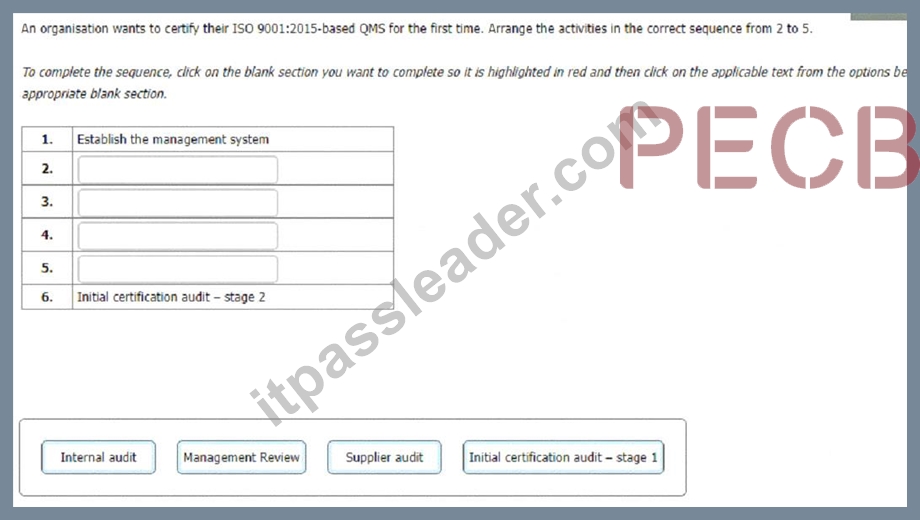
Answer:
Explanation: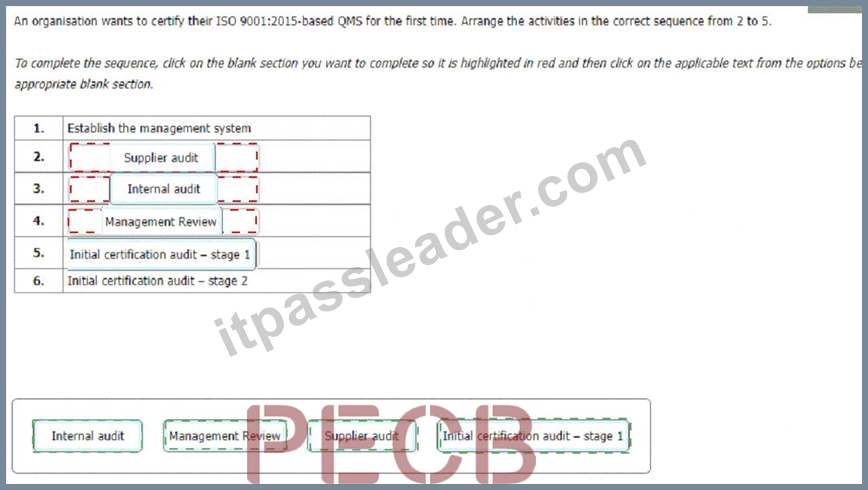
Explanation:
To certify an organization's ISO 9001:2015-based Quality Management System (QMS) for the first time, the correct sequence of activities would be:
* Establish the management system (already in place).
* Supplier audit
* Internal audit
* Management review
* Initial certification audit - stage 1
* Initial certification audit - stage 2 (already in place).
This sequence follows the typical path for preparing and ensuring that a QMS is functioning as required, leading up to certification.
NEW QUESTION # 120
How much time is usually spent on the Stage 1 audit?
- A. 30% of the total audit time
- B. 40% of the total audit time
- C. 20% of the total audit time
Answer: A
Explanation:
Comprehensive and Detailed In-Depth Explanation:
According to ISO 17021-1:2015 (Conformity Assessment - Requirements for Certification Bodies), Clause 9.3.1.2, the Stage 1 Audit typically consumes around 30% of the total audit time.
This time is allocated to:
* Reviewing documented information.
* Assessing the readiness for Stage 2.
* Identifying potential nonconformities.
A 20% allocation (Answer A) is too low, and 40% (Answer C) is excessive, as the majority of the audit should be spent on Stage 2 (on-site verification).
Reference:
ISO 17021-1:2015, Clause 9.3.1.2 (Determination of Audit Time)
NEW QUESTION # 121
Scenario 4:
TD Advertising is a print management company based in Chicago. The company offers design services, digital printing, storage, and distribution. As TD expanded, its management recognized that success depended on adopting new technologies and improving quality.
To ensure customer satisfaction and quality improvement, the company decided to pursue ISO 9001 certification.
After implementing the QMS, TD hired a well-known certification body for an audit. Anne Key was appointed as the audit team leader. She received a document listing the audit team members, audit scope, criteria, duration, and audit engagement limits.
Anne reviewed the document and approved the audit mandate. The certification body and TD's top management signed the certification agreement.
Before contacting TD, Anne reviewed the audit scope and noticed that TD made changes to it due to the adoption of new printing equipment. However, Anne disagreed with the changes, stating they would affect the audit timeline. She considered withdrawing from the audit.
The audit team members were selected based on their knowledge of the legal and other regulations that TD is subject to. Is this acceptable?
- A. No, because only one audit team member is required to have knowledge of legal and other regulatory requirements that TD is subject to.
- B. Yes, but only the lead auditor needs to have knowledge of legal and other regulatory requirements.
- C. Yes, to ensure effective conduct of the audit, each audit team member should have knowledge of legal and other requirements that TD is subject to.
- D. No, because there is no need to have knowledge of the legal and other requirements that TD is subject to.
Answer: C
Explanation:
Comprehensive and Detailed In-Depth Explanation:
ISO 9001:2015 requires organizations to ensure that auditors have the necessary competence and knowledge to conduct audits effectively.
Clause References:
* ISO 19011:2018, Clause 7.2.1 - Determining Competence of Auditors: Auditors must have knowledge of applicable legal and regulatory requirements that affect the scope of the audit.
* ISO/IEC 17021-1:2015, Clause 7.1.2 - Competence Requirements: Certification bodies must ensure that auditors assigned to the audit team possess relevant knowledge in areas such as legal and regulatory compliance.
Why is the Correct Answer C?
* Each audit team member should have sufficient knowledge of relevant legal and regulatory requirements to ensure compliance.
* This helps auditors identify gaps or nonconformities related to compliance obligations.
* Having multiple team members with knowledge reduces reliance on a single expert and ensures a comprehensive assessment.
Why are the Other Options Incorrect?
* A (Only one team member needs knowledge) # Incorrect because audits involve various aspects, and all auditors should have basic awareness of legal and regulatory requirements.
* B (Legal knowledge is not necessary) # Incorrect because compliance is essential for QMS effectiveness.
* D (Only the lead auditor needs legal knowledge) # Incorrect because ISO requires all auditors to be competent in applicable laws, not just the leader.
Reference:
ISO 19011:2018, Clause 7.2.1 - Competence of Auditors
ISO/IEC 17021-1:2015, Clause 7.1.2 - Competence Requirements
NEW QUESTION # 122
A small deaning services organisation is about to start work on a hospital dleaning contract for the local Health Trust. You, as auditor, are conducting a Stage 2 audit to ISO 9001 and review the contract with the Service Manager. The contract requires that a cleaning plan is produced. You: "How was the cleaning plan for the contract developed?" Service Manager: "We have a basic template that covers the materials, labour requirements and cleaning methods to be employed. Some of that is specified by the customer." You: "How does the plan deal with locations like the intensive care wards and the operating theatres, which are included in the contract?" Service Manager: "The basic plan covers general wards, but we will do more frequent cleaning in those areas if the hospital requests it." You: "Are you aware of the regulatory requirements for cleaning standards in hospitals?" Service Manager: "No. We depend on the hospital to look after that side of things in the contract." You decide to raise a non-conformity against section 8.2.2.a.1 of ISO 9001. You decide to raise another non-conformity against section 8.2.4 of ISO 9001 when finding that the cleaning plan was amended without the agreement of the Health Trust. A different cleaning chemical was substituted to that specified in the contract. At the follow- up audit, the corrective action proposed was to "obtain a concession from the Health Trust for use of the new chemical." Which one of the following options is the reason why you did not accept this action taken?
- A. The substitute chemical has not been used before in the Health Trust.
- B. Staff have not been trained in the use of the new chemical.
- C. The process for making changes to the contract has not been addressed.
- D. The action assumes that the Health Trust will agree to the change.
- E. The substitute chemical may not be as effective as the original.
Answer: C
Explanation:
Clause 8.2.4 of ISO 9001:2015 - Changes to Requirements for Products and Services:ISO 9001:2015 Clause
8.2.4 states that when changes to requirements for products or services are made, they must be communicated and agreed upon with relevant interested parties (in this case, the Health Trust). The lack of communication and agreement for substituting the cleaning chemical represents a clear violation of this clause.
Analysis of the Corrective Action Proposed:The organization proposed "obtaining a concession from the Health Trust for the use of the new chemical." This action is reactive and assumes approval from the Health Trust without addressing the systemic issue: the lack of a defined change control process for managing contract changes.
Option Analysis:
A). The substitute chemical has not been used before in the Health Trust:Incorrect. While this may be a concern, it is not directly relevant to the root cause of the nonconformity, which is the absence of a process to handle contract changes.
B). The action assumes that the Health Trust will agree to the change:Incorrect. Although this is true, it is not the primary issue. The nonconformity lies in the lack of a structured approach to obtain agreement, not whether the Health Trust agrees.
C). Staff have not been trained in the use of the new chemical:Incorrect. This is a separate issue related to staff competence (Clause 7.2), but it is not the main reason why the corrective action is unacceptable under Clause
8.2.4.
D). The process for making changes to the contract has not been addressed:Correct. The fundamental issue is the organization's failure to follow or establish a change control process for amending contracts, including gaining formal agreement from the Health Trust. The proposed corrective action does not ensure that such issues will be systematically prevented in the future.
E). The substitute chemical may not be as effective as the original:Incorrect. The effectiveness of the substitute chemical is secondary to the primary issue, which is the lack of a change management process.
ISO 9001 References Supporting the Correct Answer:
Clause 8.2.4: Requires that changes to product/service requirements be reviewed, communicated, and agreed upon with the customer.
Clause 10.2 (Nonconformity and Corrective Action): Requires the organization to address the root cause of the nonconformity and take actions to ensure it does not recur. In this case, the root cause is the absence of a change control process.
Why D is the Best Answer:The core issue is that the organization did not have a formalized process for managing and agreeing upon changes to contract requirements. Addressing this process gap is essential to prevent recurrence of similar nonconformities. Merely seeking a concession from the Health Trust is a one-off solution that does not address the systemic issue.
NEW QUESTION # 123
Whistlekleen is a national dry cleaning and laundry company with 50 shops. You are conducting a surveillance audit of the Head Office and are sampling customer complaints. You find that 80% of complaints originate from five shops in the same region. Most of these complaints relate to damage to customer laundry. The Quality Manager tells you that these are the oldest shops in the company. The cleaning equipment needs replacing but the company cannot afford it at the moment. You learn that the shop managers were told to dismiss most of the claims on the basis of the poor quality of the laundered materials.
On raising the matter with senior management, you are told that there are plans to replace the equipment in these shops over the next five years.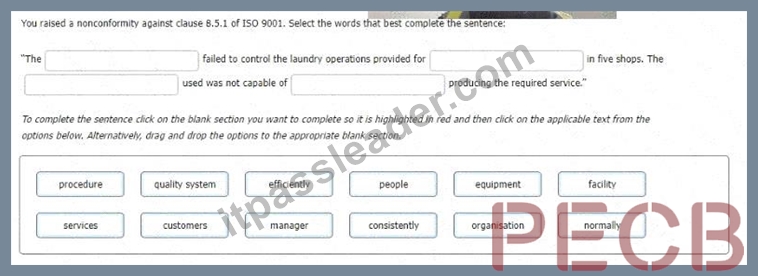
Answer:
Explanation: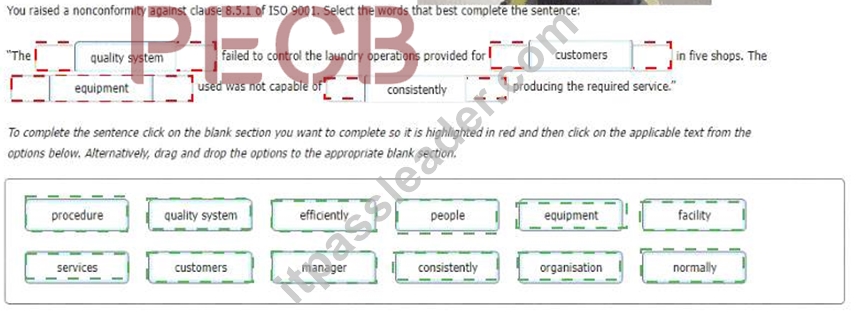
Explanation:
The quality system failed to control the laundry services provided for customers in five shops.
The equipment used was not capable of consistently producing the required service.
NEW QUESTION # 124
ISO 9001 addresses changes through several requirements, two examples of which are Clause 6.3 (Planning of Changes) and Clause 8.5.6 (Control of Changes). How do the requirements of Clause 8.5.6 differ from those of Clause 6.3?
- A. Clause 8.5.6 refers to changes during the production and service provision.
- B. Clause 8.5.6 refers to leadership and management system responsibilities.
- C. Clause 8.5.6 refers to changes to legal and regulatory requirements.
- D. Clause 8.5.6 refers to changes during the design and development of products and services.
Answer: A
Explanation:
Comprehensive and Detailed In-Depth Explanation:
ISO 9001:2015 recognizes change management as essential for maintaining process integrity and preventing nonconformities.
Clause References:
* Clause 6.3 (Planning of Changes) # Focuses on long-term changes that may impact QMS integrity.
* Clause 8.5.6 (Control of Changes) # Focuses on changes occurring during production and service provision to ensure conformity.
Why is the Correct Answer A?
* Clause 8.5.6 applies specifically to operational changes, ensuring that modifications in production or service processes do not compromise quality.
* Organizations must document who approves changes, how they are controlled, and how they affect product/service conformity.
Why are the Other Options Incorrect?
* B (Changes during design and development) # Covered under Clause 8.3 (Design and Development), not 8.5.6.
* C (Changes to legal and regulatory requirements) # Addressed under Clause 4.2 (Interested Parties
' Requirements).
* D (Leadership responsibilities) # Covered under Clause 5.1 (Leadership and Commitment), not
8.5.6.
NEW QUESTION # 125
Who is responsible for the development of surveillance activities?
- A. A representative of the auditee's top management
- B. The audit team leader
- C. The certification body
Answer: C
Explanation:
Comprehensive and Detailed In-Depth Explanation:
According to ISO 17021-1:2015, Clause 9.6.2 (Surveillance Activities):
* The certification body is responsible for planning and conducting surveillance audits to ensure continued compliance.
* The auditee's top management (A) does not develop surveillance activities, but they must participate.
* The audit team leader (C) conducts the surveillance audit, but they do not develop the program.
Thus, B is the correct answer.
Reference:
ISO 17021-1:2015, Clause 9.6.2 (Surveillance Activities)
NEW QUESTION # 126
Scenario 1: AL-TAX is a company located in California which provides financial and accounting services. The company manages the finances of 17 companies and now is seeking to expand their business even more The CEO of AL-TAX, Liam Durham, claims that the company seeks to provide top- notch services to their clients Recently, there were a number of new companies interested in the services provided by AL-TAX.
In order to fulfill the requirements of new clients and further improve quality, Liam discussed with other top management members the idea of implementing a quality management system (QMS) based on ISO 9001. During the discussion, one of the members of the top management claimed that the size of the company was not large enough to implement a QMS. In addition, another member claimed that a QMS is not applicable for the industry in which AL TAX operates. However, as the majority of the members voted for implementing the QMS. Liam initiated the project.
Initially, Liam hired an experienced consultant to help AL-TAX with the implementation of the QMS.
They started by planning and developing processes and methods for the establishment of a QMS based on ISO 9001. Furthermore, they ensured that the quality policy is appropriate to the purpose and context of AL TAX and communicated to all employees. In addition, they also tried to follow a process that enables the company to ensure that its processes are adequately resourced and managed, and that improvement opportunities are determined.
During the implementation process, Liam and the consultant focused on determining the factors that could hinder their processes from achieving the planned results and implemented some preventive actions in order to avoid potential nonconformities Six months after the implementation of the QMS.
AL-TAX conducted an internal audit. The results of the internal audit revealed that the QMS was not fulfilling all requirements of ISO 9001. A serious issue was that the QMS was not fulfilling the requirements of clause 5.1.2 Customer focus and had also not ensured clear and open communication channels with suppliers.
Throughout the next three years, the company worked on improving its QMS through the PDCA cycle in the respective areas. To assess the effectiveness of the intended actions while causing minimal disruptions, they tested changes that need to be made on a smaller scale. After taking necessary actions, AL-TAX decided to apply for certification against ISO 9001.
Based on the scenario above, answer the following question:
Scenario 1 indicates that AL-TAX did not ensure clear and open communication channels with interested parties. Which quality management principle did the organization not follow in this case?
- A. Relationship management
- B. Leadership
- C. Evidence-based decision making
Answer: A
Explanation:
Comprehensive and Detailed In-Depth Explanation:ISO 9001:2015 is based on seven quality management principles, one of which is Relationship Management. This principle emphasizes the importance of maintaining open communication and collaboration with interested parties, including suppliers and customers.
Clause 7.4 (Communication) requires organizations to determine what, when, with whom, and how communication should take place. Since AL-TAX failed to ensure clear communication channels, it did not adhere to this principle. Effective relationship management helps improve supply chain performance, customer satisfaction, and overall QMS effectiveness.
NEW QUESTION # 127
What competence, among others, should each audit team member have?
- A. Expertise in each domain to be audited.
- B. A formal degree in quality management.
- C. Knowledge of the industry in which the auditee operates.
- D. Knowledge of the risk-based approach to auditing.
Answer: D
Explanation:
Comprehensive and Detailed In-Depth Explanation:
Auditors must have competence in risk-based auditing to effectively assess an organization's QMS performance and compliance.
Clause References:
* ISO 19011:2018, Clause 7.2.3 - Determining Auditor Competence:
* Auditors must have knowledge of risk-based thinking to assess risk impact on processes.
* ISO 9001:2015, Clause 0.3.3 - Risk-Based Thinking:
* The standard emphasizes proactive risk management, which auditors must understand.
Why is the Correct Answer B?
* Risk-based auditing ensures audits focus on high-risk areas, improving audit effectiveness.
* Auditors must assess how organizations apply risk-based thinking in decision-making, process control, and improvement.
Why are the Other Options Incorrect?
* A (Industry knowledge) # While helpful, it is not mandatory for all auditors.
* C (Expertise in all domains) # Auditors are not required to be experts in all areas, just in audit methodology.
* D (Formal degree in quality management) # ISO does not require a formal degree, just competence in audit principles and methods.
NEW QUESTION # 128
Takitup is a small fabrication organisation that manufactures steel fencing, stairs and platforms for the construction sector. It has been certified to ISO 9001 for some time and has appointed a new Quality Manager.
The audit plan during a surveillance audit covers the organisation's improvement actions and the auditor asks to see the most recent management review meeting minutes.
The auditor finds that the management review report records that none of the improvement actions set by the previous review has been realised for a second time. A new Quality Manager has been brought in at the middle management level to rectify the situation as the organisation is concerned that it might lose its certification.
Select three options that would provide evidence of conformance with clause 10.3 of ISO 9001.
- A. An enhanced customer satisfaction survey score than in the previous year.
- B. Considering results from the analysis of the effectiveness of corrective actions to determine improvement opportunities.
- C. Removing expensive external providers from the database.
- D. An increase in the number of quality staff.
- E. A quality objective to achieve lower reject rates by quality control.
- F. Automate the fabrication process to increase profitability.
- G. Outsource more processes to external providers
- H. The certification body auditor reporting fewer nonconformities.
Answer: A,B,E
NEW QUESTION # 129
Scenario 5: Mechanical-Electro (ME) Audit Stages
Mechanical-Electro, better known as ME, is an American company that provides mechanical and electrical services in China. Their services range from air-conditioning systems, ventilation systems, plumbing, to installation of electrical equipment in automobile plants, electronic manufacturing facilities, and food processing plants.
Due to the fierce competition from local Chinese companies and failing to meet customer requirements, ME's revenue dropped significantly. In addition, customers' trust and confidence in the company decreased, and the reputation of the company was damaged.
In light of these developments, the top management of ME decided to implement a quality management system (QMS) based on ISO 9001. After having an effective QMS in place for over a year, they applied for a certification audit.
A team of four auditors was appointed for the audit, including Li Na as the audit team leader. Initially, the audit team conducted a general review of ME's documents, including the quality policy, operational procedures, inventory lists, QMS scope, process documentation, training records, and previous audit reports.
Li Na stated that this would allow the team to maintain a systematic and structured approach to gathering documents for all audit stages. While reviewing the documented information, the team observed some minor issues but did not identify any major nonconformities. Therefore, Li Na claimed that it was not necessary to prepare a report or conduct a meeting with ME's representatives at that stage of the audit. She stated that all areas of concern would be discussed in the next phase of the audit.
Following the on-site activities and the opening meeting with ME's top management, the audit team structured an audit test plan to verify whether ME's QMS conformed to Clause 8.2.1 (Customer Communication) of ISO 9001.
To do so, they gathered information through group interviews and sampling. Li Na conducted interviews with departmental managers in the first group and then with top management. In addition, she chose a sampling method that sufficiently represented customer complaints from both areas of ME' s operations.
The team members were responsible for the sampling procedure. They selected a sample size of 4 out of
45 customer complaints received weekly for electrical services and 2 out of 10 complaints for mechanical services.
Afterward, the audit team evaluated the evidence against the audit criteria and generated the audit findings.
According to scenario 5, Li Na conducted group interviews with departmental managers and top management by herself. Is this in accordance with audit best practices?
- A. No, two auditors should be present in case of group interviews.
- B. Yes, the auditee's top management is always interviewed by the audit team leader only.
- C. Yes, only the audit team leader should conduct group interviews.
Answer: A
Explanation:
Comprehensive and Detailed In-Depth Explanation:According to ISO 19011:2018, Clause 6.4.6 (Conducting Interviews), group interviews should be conducted with at least two auditors to ensure objectivity and accuracy.
* This prevents bias or misinterpretation of responses.
* It allows for cross-validation of information.
* It ensures that the audit results remain objective and impartial.
Since Li Na conducted the group interviews alone, she did not follow audit best practices. The correct approach would have been to have another auditor present during the interviews.
NEW QUESTION # 130
Among others, what does Clause 4.4 (Quality Management System and Its Processes) of ISO 9001 require from organizations?
- A. To change the QMS quarterly
- B. To conduct a QMS gap analysis every two years
- C. To review the QMS annually
- D. To continually improve the QMS
Answer: D
Explanation:
Comprehensive and Detailed In-Depth Explanation:
ISO 9001:2015 emphasizes continual improvement as a fundamental requirement of an effective Quality Management System (QMS).
Clause Reference:
* Clause 4.4.1 (Quality Management System and Its Processes) states that organizations must:
* Determine processes needed for the QMS
* Establish criteria and methods for process effectiveness
* Ensure continual improvement of the system
Why is the Correct Answer C?
* Continual improvement is a core principle of ISO 9001.
* Organizations must regularly assess and enhance their QMS to adapt to new challenges and maintain effectiveness.
Why are the Other Options Incorrect?
* A (To change the QMS quarterly) # ISO 9001 does not mandate a specific frequency for system changes.
* B (To review the QMS annually) # QMS reviews must be conducted as needed, not strictly annually.
* D (To conduct a QMS gap analysis every two years) # Gap analysis is useful but is not a mandatory requirement under Clause 4.4.
Reference:
ISO 9001:2015, Clause 4.4 - Quality Management System and Its Processes
NEW QUESTION # 131
Scenario 6: Davis Clinic (DC) is an American medical center focused on integrated health care. Since its establishment DC was committed to providing qualitative services for its clients, which is the reason why the company decided to implement a quality management system (QMS) based on ISO 9001. After a year of having an active QMS in place, DC applied for a certification audit.
A team of five auditors, from a well-known certification body, was selected to conduct the audit. Eva was appointed as the audit team leader. After three days of auditing, the team gathered to review and examine their findings. They also discussed the audit findings with DC's top management and then drafted the audit conclusions.
In the closing meeting, which was held between the audit team and the top management of DC. Eva presented two nonconformities that were detected during the audit. Eva stated that the company did not retain documented information regarding its outsourced services for an analysis laboratory and regarding the conducted management reviews. During the closing meeting, the audit team required from DCs top management to come up with corrective action plans within two weeks. Although the top management did not agree with the audit findings, the audit team insisted that the auditee must submit corrective actions within the given time frame in order for the audit activities to continue.
Once the action plans were evaluated, the audit team began preparing the audit report. Eva required from the team to provide accurate descriptions of the audit findings and the audit conclusions. The report was then distributed to all the interested parties involved in the audit, including the certification body Based on the report, the certification body together with Eva, as the audit team leader, made the certification decision.
Based on the scenario above, answer the following question:
Is it acceptable for the certification body and Eva to make the certification decision together?
- A. Yes, because the audit team leader must be involved in the certification decision
- B. No, auditors that take part in the audit should never take part in the certification decision
- C. No, only the audit team leader must make the certification decision
Answer: B
Explanation:
Comprehensive and Detailed In-Depth Explanation:
According to ISO 17021-1:2015, Clause 9.5.1 (Certification Decision):
* Auditors who conduct the audit cannot be involved in the certification decision to ensure impartiality.
* The certification body alone is responsible for making the certification decision based on the audit report and findings.
* The audit team leader (Eva) must not take part in the certification decision.
Thus, C is the correct answer.
Reference:
ISO 17021-1:2015, Clause 9.5.1 (Certification Decision)
NEW QUESTION # 132
......
PECB ISO-9001-Lead-Auditor Exam Syllabus Topics:
| Topic | Details |
|---|---|
| Topic 1 |
|
| Topic 2 |
|
| Topic 3 |
|
Valid Way To Pass PECB's ISO-9001-Lead-Auditor Exam with : https://exam-labs.itpassleader.com/PECB/ISO-9001-Lead-Auditor-dumps-pass-exam.html