

Plat-Dev-301 Certification Exam Dumps Questions in here [Aug-2026]
Updated Plat-Dev-301 Exam Practice Test Questions
NEW QUESTION # 77
A developer created a Lightning web component mat allows users to Input a text value that is used to search for Accounts by calling an Apex method. The Apex method returns a list of account to apply and is called imperatively from a JavaScript event handler.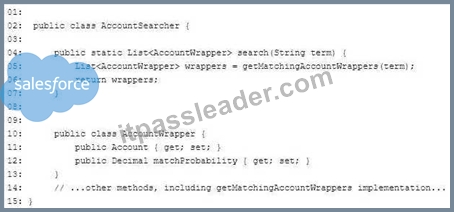
Which two changes should the developer make so the Apex method functions correctly. Choose 2 answers
- A. Add @AuraEnabled to line 09.
- B. Add @AuraEnabled to line 03.
- C. Add @AuraEnabled to line 01.
- D. Add @AuraEnabled to lines 11 and 12.
Answer: B,D
NEW QUESTION # 78
What are three reasons that a developer should write Jest tests for Lightning web components?
Choose 3 answers
- A. To verify the DOM output of a component
- B. To test basic user interaction
- C. To test a component's non-public properties.
- D. To test how multiple components work together
- E. To verify that events fire when expected
Answer: A,B,C
Explanation:
Jest tests are essential for developing Lightning Web Components (LWC) because they allow developers to ensure the quality and correctness of their components in isolation from the rest of the application. Reason A is incorrect because testing non-public properties breaks encapsulation and is considered bad practice. B is correct because Jest tests can simulate user interactions with the component, such as clicking buttons or entering text, to ensure it behaves as expected. C is correct as well because Jest tests can confirm that the component renders the expected DOM output, which is crucial for ensuring that the HTML structure of the component is accurate. D is not the best choice since Jest is more suited for testing components in isolation rather than how multiple components interact; integration tests are more appropriate for that. Lastly, E is correct because Jest tests can verify that events are fired at the appropriate times, which is a critical part of the component's interaction with the rest of the application.
Reference
Jest Testing: Lightning Web Components Testing
Jest Testing Best Practices: Lightning Web Components Jest Best Practices
NEW QUESTION # 79
An org has a requirement that addresses on Contacts and Accounts should be normalized to a company standard by Apex code any time that they are saved.
What is the optimal way to implement this?
- A. Apex triggers on Contact and Account that call a helper class to normalize the address
- B. Apex triggers on Contact and Account that normalize the address
- C. Apex trigger on Account that calls the Contact trigger to normalize the address
- D. Apex trigger on Contact that calls the Account trigger to normalize the address
Answer: A
Explanation:
Apex triggers on Contact and Account with a helper class is the best practice for code reuse and maintaining clean trigger logic.
NEW QUESTION # 80
Which three actions must be completed in a Lightning web component for a JavaScript file In a static resource to be loaded? Choose 3 answers
- A. Append the static resource to the DOM.
- B. Reference the static resource in a <script> tag.
- C. Call loadScript.
- D. Import the static resource.
- E. Import a method from the platformResourceLoader.
Answer: C,D,E
NEW QUESTION # 81
Universal Containers uses a custom Lightning page to provide a mechanism to perform a step-by-step wizard search for Accounts. One of the steps in the wizard is to allow the user to input text into a text field, ERF Number_c, that is then used in a query to find matching Accounts.
Which step should be taken to resolve the issue?
- A. Mark the ERP_Number__ c field as required.
- B. Mark the ERP_Numker = field as an external ID.
- C. Perform the SOQL query as part of a for loop.
- D. Move the SO0L query to within an asynchronous process.
Answer: D
Explanation:
If a SOQL query is causing performance issues due to a non-selective query on a large data volume, moving the query to an asynchronous process such as a Batch Apex or Queueable Apex can help resolve the issue. This allows the query to run in the background without affecting the user's experience.
NEW QUESTION # 82
As part of a custom interface, a developer team creates various new Lightning web components. Each of the components handles errors using toast messages. When the development is complete, all the components are added to the same Lightning page.
During acceptance testing, users complain about the long chain of toast messages that display when errors occur loading the components.
Which two techniques should the developer implement to improve the user experience?
Choose 2 answers
- A. Use a Lightning web component to aggregate and display all errors
- B. Use a <tamplate> tag to display in-place error messages.
- C. Use public, properties on each component to display the error messages.
- D. Use the window.alert() method to display the error messages
Answer: A,C
Explanation:
The scenario describes a common issue when multiple components are used on the same Lightning page and each component manages its error handling independently, leading to a "long chain of toast messages" which can be overwhelming for users.
To improve user experience, the developers can implement the following techniques:
A . Use a Lightning web component to aggregate and display all errors: This method involves creating a centralized component responsible for handling all error messages. This component would receive error notifications from other components and then display them in a user-friendly manner. The benefit of this approach is that it provides a single, consistent interface for error messages, reducing the clutter and confusion that can be caused by multiple toasts.
D . Use public properties on each component to display the error messages: By using public properties, components can expose their error states to a parent or orchestrating component, which can then display these errors in a single, consolidated way. This avoids the issue of multiple toast notifications and allows for a more integrated error handling experience.
The other options presented are less ideal:
B . Using the window.alert() method is not recommended in a professional Salesforce environment as it is considered a disruptive way to show errors and does not align with the Salesforce Lightning design system.
C . Using a <template> tag to display in-place error messages could be a viable option for displaying error messages within the component itself, but it does not address the issue of multiple errors stacking up from different components as described in the scenario.
For building a centralized error handling component: Lightning Web Components Developer Guide - Error Handling For implementing public properties: Lightning Web Components Developer Guide - Public Properties
NEW QUESTION # 83
A developer is asked to build a solution that will automatically send an email to the customer when an Opportunity stage changes. The solution must scale to allow for 10,000 emails per day. The criteria to send the email should be evaluated after certain conditions are met.
What is the optimal way to accomplish this?
- A. Use an Email Alert with Flow Builder.
- B. Use a Workflow Email Alert.
- C. Use MassEmailMEssage () With an Apex trigger.
- D. Use SingleEmailMessage() with an Apex trigger.
Answer: A
Explanation:
Using an Email Alert with Flow Builder allows for scalable solutions that can handle large volumes of emails, and it offloads the processing from Apex to Salesforce's declarative automation tools. This approach is also bulk-safe, as it does not rely on Apex code that could hit governor limits.
NEW QUESTION # 84
A corporation has many different Salesforce orgs, with some different objects and some common objects, and wants to build a single Java application that can create, retrieve, and update common object records in all of the different orgs.
Which method of integration should the application use?
- A. SOAP API with the Partner WSDL
- B. Metadata APT
- C. SOAP API with the Enterprise WSDL
- D. Apex REST Web Service
Answer: A
Explanation:
The SOAP API with the Partner WSDL is ideal for building integrations that work across multiple Salesforce orgs, especially when they have varying schemas. The Partner WSDL is designed to be flexible and dynamic, catering to different metadata.
NEW QUESTION # 85
Which statement is considered a best practice for writing bulk safe Apex triggers?
- A. Use the Database methods with allorNone set to £21s= instead of DML statements.
- B. Add LIMIT 50000 to every SOQL statement.
- C. Add records to collections and perform DML operations against these collections.
- D. Perform all DML operations from within a future method.
Answer: C
Explanation:
Bulk-safe triggers use collections to aggregate DML operations. This practice minimizes the number of DML statements, which is essential for bulk processing.
NEW QUESTION # 86
Universal Containers implements a private sharing model for the Convention Attendee co custom object. As part of a new quality assurance effort, the company created an Event_Reviewer_c user lookup field on the object.
Management wants the event reviewer to automatically gain ReadWrite access to every record they are assigned to.
What is the best approach to ensure the assigned reviewer obtains Read/Write access to the record?
- A. Create an after insert trigger on the Convention Attendee custom object, and use Apex Sharing Reasons and Apex Managed Sharing.
- B. Create criteria-based sharing rules on the Convention Attendee custom object to share the records with the Event Reviewers,
- C. Create a criteria-based sharing rule on the Convention Attendee custom object to share the records with a group of Event Reviewers.
- D. Create a before insert trigger on the Convention Attendee custom object, and use Apex Sharing Reasons and Apex Managed Sharing.
Answer: A
Explanation:
Use Apex Managed Sharing with an after insert trigger. It allows dynamic record sharing based on user-defined criteria like the Event_Reviewer_c field.
NEW QUESTION # 87
A developer is asked to find a way to store sacret data with an ability to specify which profiles and users can access which secrets.
What should be used to store this data?
- A. Static resources
- B. Custom metadata
- C. Custom settings
- D. system.Cookie class
Answer: B
Explanation:
Custom metadata types are the optimal way to store secret data that needs to be accessed by certain profiles and users. Access to custom metadata records can be controlled by the Salesforce sharing model.
NEW QUESTION # 88
Assuming the CreateOneAccount class creates one account and implements the Queueable interface, which syntax properly tests the Apex code?
A)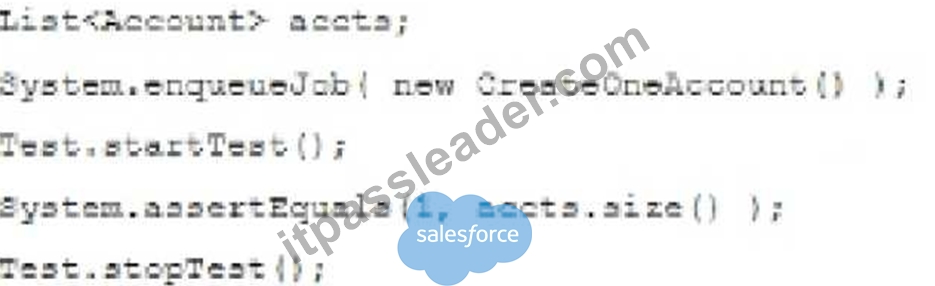
B)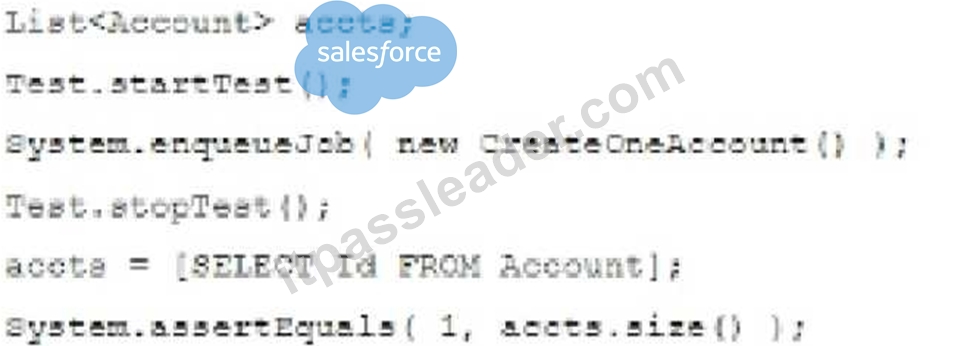
C)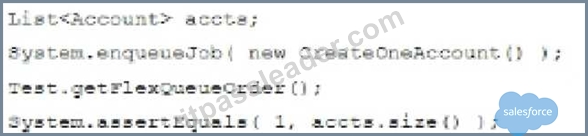
D)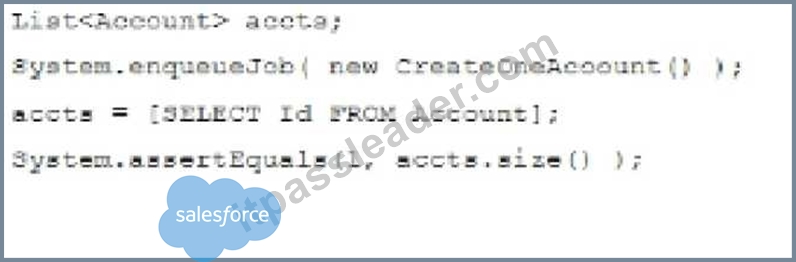
- A. Option D
- B. Option A
- C. Option B
- D. Option C
Answer: C
Explanation:
To test Queueable Apex, Test.startTest() and Test.stopTest() should be used to ensure the asynchronous code is executed before assertions are made. After calling Test.stopTest(), you would then query for the records to assert that the queueable job correctly created the Account records.
NEW QUESTION # 89
A company has a custom component that allows users to search for records of a certain object type by invoking an Apex Controller that returns a list of results based on the user's input. When the search is completed, a searchComplete event is fired, with the results put in a results attribute of the event. The component is designed to be used within other components and may appear on a single page more than once.
What is the optimal code that should be added to fire the event when the search has completed?
A)
B)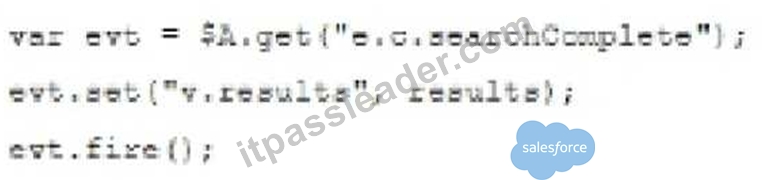
C)
D)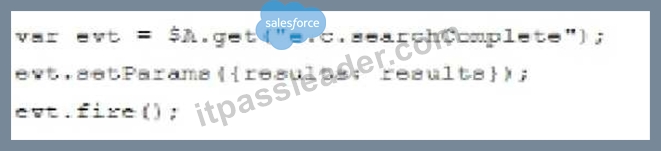
- A. Option D
- B. Option A
- C. Option B
- D. Option C
Answer: C
Explanation:
The correct code to fire the event when the search has completed in a Lightning component is option B. $A.get("e.c.searchComplete") is the syntax used to get the event, setParams is used to set the parameters, and fire is used to dispatch the event.
NEW QUESTION # 90
Consider the Apex class below that defines a RemoteAction used on 2 Visualforce search page.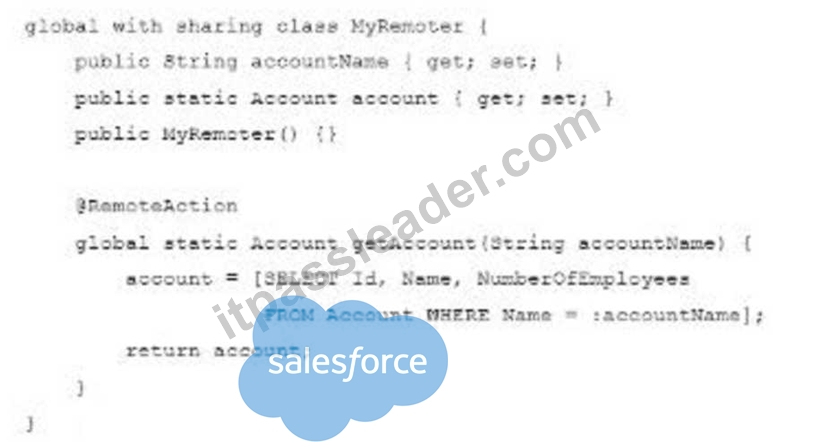
Which code snippet will assert that the remote action returned the correct Account? A)
B)
C)
D)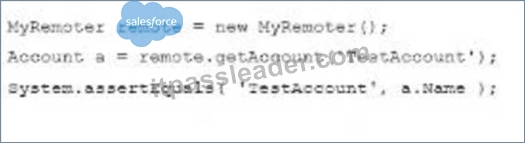
- A. Option D
- B. Option B
- C. Option A
- D. Option C
Answer: D
Explanation:
The correct code snippet to assert that the remote action returned the correct Account is option C. This is because the getAccount method is a global static method within the MyRemoter class and can be directly called without needing to instantiate an object of the class.
NEW QUESTION # 91
An org has an existing process, built using Process Builder, on Opportunity that sets a custom field, CommissionBaseAmount__c, when an Opportunity is edited and the Opportunity's Amount changes.
A developer recently deployed an Opportunity before update trigger that uses the CommissionBaseAmount__c and complex logic to calculate a value for a custom field, CommissionAmount__c, when an Opportunity stage changes to Closed/Won.
Users report that when they change the Opportunity to Closed/Won and also change the Amount during the same save, the CommissionAmount__c is incorrect.
Which action should the developer take to correct this problem?
- A. Call the process from the trigger.
- B. Call the trigger from the process.
- C. A Replace the process with a Fast Field Update record-trigger flow.
Answer: C
Explanation:
The issue described is likely due to the order of execution in Salesforce, where processes in Process Builder run after all before triggers. If the Opportunity's Amount is changed and the CommissionBaseAmount__c is set by Process Builder, the trigger that calculates CommissionAmount__c may not see the updated value if it operates before the process.
Replacing the process with a before-save record-triggered flow (formerly known as Fast Field Update) would ensure that CommissionBaseAmount__c is updated before the trigger runs. In a before-save flow, field updates occur before any Apex before update triggers fire, which means the trigger would have the updated value of CommissionBaseAmount__c to use in its calculation.
eferences:
Order of Execution in Salesforce
Before-Save Record-Triggered Flows
NEW QUESTION # 92
For compliance purposes, a company is required to track long-term product usage in their org. The information that they need to log will be collected from more than one object and, over time, they predict they will have hundreds of millions of records.
What should a developer use to implement this?
- A. Setup audit trail
- B. Field history tracking
- C. Field audit trail
- D. Big objects
Answer: D
Explanation:
Big objects provide a solution for storing and managing large amounts of data within Salesforce. They are ideal for compliance purposes when tracking long-term usage data that will accumulate over time into very large record counts.
NEW QUESTION # 93
Universal Containers decided to use Salesforce to manage a new hire interview process. A custom object called Candidate was created with organization-wide defaults set to Private. A lookup on the Candidate object sets an employee as an Interviewer.
What should be used to automatically give Read access to the record when the lookup field is set to the Interviewer user?
- A. The record can be shared using a sharing rule.
- B. The record cannot he shared with the current setup.
- C. The record can be shared using an Apex class.
- D. The record can be shared using a permission set.
Answer: A
Explanation:
A sharing rule can be used to automatically give Read access to a user specified in a lookup field. Sharing rules are declarative and can be based on criteria such as the value of a lookup field. This can be done without writing code and is maintainable through the Salesforce UI.
NEW QUESTION # 94
What is the best practice to initialize a Vizualforce page in a test class?
- A. Use Test. setCurrentPage MyTestPags;
- B. Use Test. currantPage .getParamatars put (MyTaestPaga) ;
- C. Use Test. setCurrentPage (Page. MyTeatPage);
- D. Use controller. currentPage. setPage (MyTastfage) ;
Answer: C
Explanation:
Test.setCurrentPage(Page.MyTestPage) is used to set the context to a Visualforce page in tests, allowing you to simulate a page request in a test method.
NEW QUESTION # 95
A developer wrote a class named asccuntRisteryManager that relies on field history tracking. The class has a static method called getaccountHistory that Lakes in an Account as a parameter and returns a list of associated accountHistory object records.
The following test fails: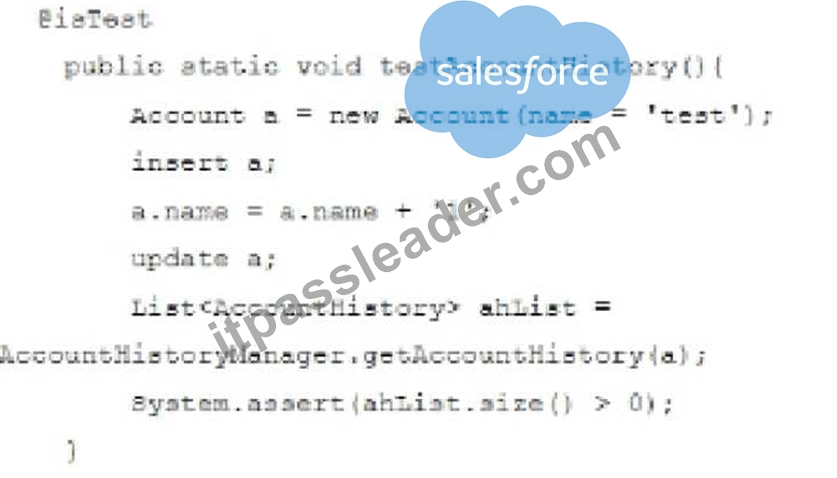
What should be done to make this test pass?
- A. The tact method should he delated since this code cannat be tested
- B. Use Test. isRunningTest (] in getAccountHistory() to conditionally return fake AccountHistory records.
- C. Create Accountdistory records manually in the test setup and write a query to get them.
- D. Use @isTest (SeeAllData=true] to see historical data from the org and query for Accountdistory records.
Answer: D
Explanation:
To make the test pass, @isTest(SeeAllData=true) should be used to allow the test to access historical data from the org. This is required because field history tracking data is not copied to a test context, so you need to allow the test to access live data to assert against it.
NEW QUESTION # 96
Refer to the component code and requirements below: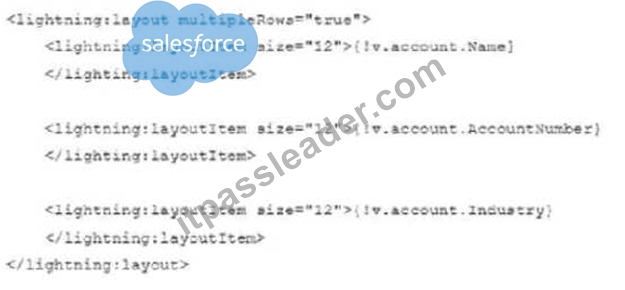
A)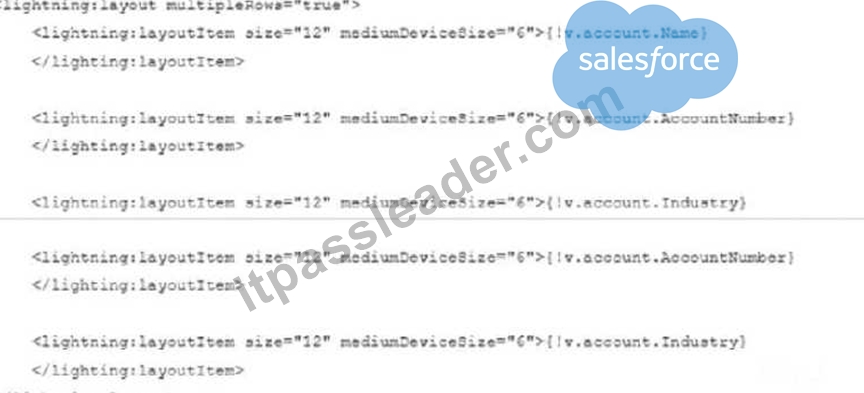
B)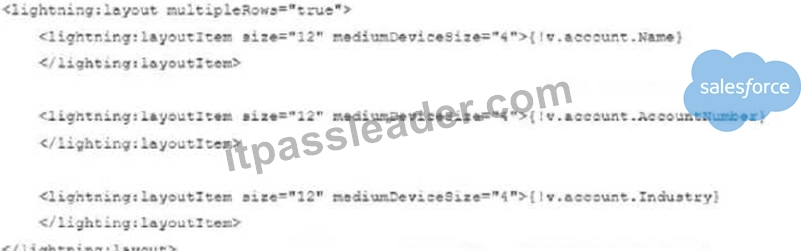
C)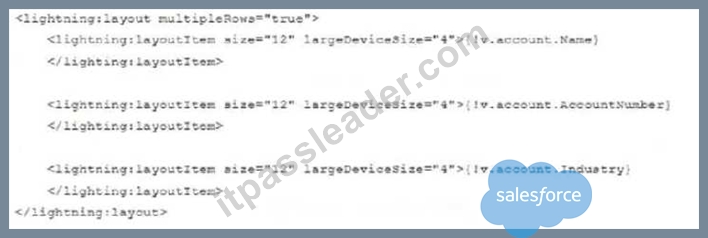
D)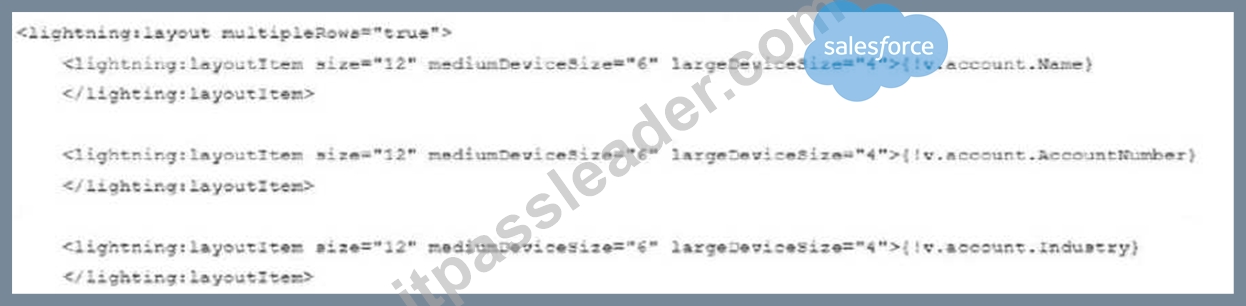
- A. Option D
- B. Option A
- C. Option B
- D. Option C
Answer: C
NEW QUESTION # 97
A company uses Dpportunities to track sales to their customers and their org has millions of Opportunities. They want to begin to track revenue over time through a related Revenue object.
As part of their initial implementation, they want to perform a one-time seeding of their data by automatically creating and populating Revenue records for Opportunities, based on complex logic.
They estimate that roughly 100,000 Opportunities will have Revenue records created and populated.
What is the optimal way to automate this?
- A. Use Database. executeBatch () to invoke a Queueable class.
- B. Use system, enqueuJob (| to invoke a gueusable class.
- C. Use system, acheduladeb() to schedule a patakape.Scheduleable class.
- D. Use Database. =executeBatch() to invoke a Database. Batchable class.
Answer: D
Explanation:
For a one-time bulk operation on a large data set, using a Database.Batchable class is the best approach. This allows complex logic to be processed in manageable chunks and efficiently manages system resources.
NEW QUESTION # 98
Which two best practices should the developer implement to optimize this code? Choose 2 answers
- A. Remove the DML statement.
- B. Query the Driving-Structure_C records outside of the loop
- C. Change the trigger context to after update, after insert
- D. Use a collection for the DML statement.
Answer: B,D
Explanation:
To optimize the code in question, it's important to follow best practices that reduce the number of SOQL queries and DML statements within loops, as these can quickly consume governor limits and lead to inefficiencies. Option C is correct because using a collection to hold records and performing a single DML operation outside of loops reduces the number of DML operations, which is a best practice for bulkifying code in Salesforce. Option D is also correct because querying records outside of a loop prevents hitting SOQL governor limits and makes the code more efficient. Options A and B are not correct in the context provided, as there isn't enough information to determine if changing the trigger context is necessary, and removing the DML statement altogether may not be feasible if the logic requires data to be persisted.
Reference
Apex Best Practices: Apex Developer Guide Best Practices
NEW QUESTION # 99
An environment has two Apex triggers: an after-update trigger on Account and an after-update trigger on Contact.
The Account after-update trigger fires whenever an Account's address is updated, and it updates every associated Contact with that address. The Contact after-update trigger fires on every edit, and it updates every Campaign Member record related to the Contact with the Contact's state.
Consider the following: A mass update of 200 Account records' addresses, where each Account has 50 Contacts. Each Contact has one Campaign Member. This means there are 10,000 Contact records across the Accounts and 10,000 Campaign Member records across the contacts.
What will happen when the mass update occurs?
- A. There will be no error and all updates will succeed, since the limit on the number of records processed by DML statements was not exceeded.
- B. The mass update will fail, since the two triggers fire in the same context, thus exceeding the number of records processed by DML statements.
- C. There will be no error, since each trigger fires within its own context and each trigger does not exceed the limit of the number of records processed by DML statements.
- D. The mass update of Account address will succeed, but the Contact address updates will fail due to exceeding number of records processed by DML statements.
Answer: B
Explanation:
In this scenario, the governor limit for DML statements (150 DML operations and 10,000 DML rows per transaction) will be exceeded because the updates will cascade across related objects, significantly multiplying the number of records processed.
Apex Developer Guide
NEW QUESTION # 100
A developer created a Lightning web component that uses a lightning-record-edit-form to collect information about Leads. Users complain that they only see one error message at a time about their input when trying to save a Lead record.
What is the recommended approach to perform validations on more than one field, and display multiple error messages simultaneously with minimal JavaScript intervention?
- A. Validation rules
- B. External JavaScript library
- C. Apex trigger
- D. Try/catch/finally block
Answer: B
Explanation:
Salesforce validation rules are declarative and can be used to validate more than one field on an object and display multiple error messages. This approach requires minimal JavaScript code and uses Salesforce's built-in validation framework. Reference:
Validation Rules
NEW QUESTION # 101
......
Pass Salesforce Developer Plat-Dev-301 Exam With 204 Questions: https://exam-labs.itpassleader.com/Salesforce/Plat-Dev-301-dumps-pass-exam.html