

Easily To Pass New FCSS_SOC_AN-7.4 Premium Exam Updated [Dec 30, 2025]
FCSS_SOC_AN-7.4 Certification All-in-One Exam Guide Dec-2025
NEW QUESTION # 42
Which statement describes automation stitch integration between FortiGate and FortiAnalyzer?
- A. A security profile on FortiGate triggers a violation and FortiGate sends a webhook call to FortiAnalyzer.
- B. An automation stitch is configured on FortiAnalyzer and mapped to FortiGate using the FortiOS connector.
- C. An event handler on FortiAnalyzer is configured to send a notification to FortiGate to trigger an automation stitch.
- D. An event handler on FortiAnalyzer executes an automation stitch when an event is created.
Answer: A
Explanation:
* Overview of Automation Stitches: Automation stitches in Fortinet solutions enable automated responses to specific events detected within the network. This automation helps in swiftly mitigating threats without manual intervention.
* FortiGate Security Profiles:
* FortiGate uses security profiles to enforce policies on network traffic. These profiles can include antivirus, web filtering, intrusion prevention, and more.
* When a security profile detects a violation or a specific event, it can trigger predefined actions.
* Webhook Calls:
* FortiGate can be configured to send webhook calls upon detecting specific security events.
* A webhook is an HTTP callback triggered by an event, sending data to a specified URL. This allows FortiGate to communicate with other systems, such as FortiAnalyzer.
* FortiAnalyzer Integration:
* FortiAnalyzer collects logs and events from various Fortinet devices, providing centralized logging and analysis.
* Upon receiving a webhook call from FortiGate, FortiAnalyzer can further analyze the event, generate reports, and take automated actions if configured to do so.
* Detailed Process:
* Step 1: A security profile on FortiGate triggers a violation based on the defined security policies.
* Step 2: FortiGate sends a webhook call to FortiAnalyzer with details of the violation.
* Step 3: FortiAnalyzer receives the webhook call and logs the event.
* Step 4: Depending on the configuration, FortiAnalyzer can execute an automation stitch to respond to the event, such as sending alerts, generating reports, or triggering further actions.
* References:
* Fortinet Documentation: FortiOS Automation Stitches
* FortiAnalyzer Administration Guide: Details on configuring event handlers and integrating with FortiGate.
* FortiGate Administration Guide: Information on security profiles and webhook configurations.
By understanding the interaction between FortiGate and FortiAnalyzer through webhook calls and automation stitches, security operations can ensure a proactive and efficient response to security events.
NEW QUESTION # 43
What role do outbreak alert handlers play in a SOC?
- A. They facilitate corporate mergers and acquisitions.
- B. They predict stock market changes.
- C. They provide automated responses to detected outbreaks.
- D. They coordinate marketing campaigns.
Answer: C
NEW QUESTION # 44
Which three end user logs does FortiAnalyzer use to identify possible IOC compromised hosts? (Choose three.)
- A. Web filter logs
- B. Email filter logs
- C. DNS filter logs
- D. Application filter logs
- E. IPS logs
Answer: A,C,E
Explanation:
Overview of Indicators of Compromise (IoCs): Indicators of Compromise (IoCs) are pieces of evidence that suggest a system may have been compromised. These can include unusual network traffic patterns, the presence of known malicious files, or other suspicious activities.
FortiAnalyzer's Role: FortiAnalyzer aggregates logs from various Fortinet devices to provide comprehensive visibility and analysis of network events. It uses these logs to identify potential IoCs and compromised hosts.
Relevant Log Types:
DNS Filter Logs:
DNS requests are a common vector for malware communication. Analyzing DNS filter logs helps in identifying suspicious domain queries, which can indicate malware attempting to communicate with command and control (C2) servers.
Reference: Fortinet Documentation on DNS Filtering FortiOS DNS Filter IPS Logs:
Intrusion Prevention System (IPS) logs detect and block exploit attempts and malicious activities.
These logs are critical for identifying compromised hosts based on detected intrusion attempts or behaviors matching known attack patterns.
Reference: Fortinet IPS Overview FortiOS IPS
Web Filter Logs:
Web filtering logs monitor and control access to web content. These logs can reveal access to malicious websites, download of malware, or other web-based threats, indicating a compromised host.
Reference: Fortinet Web Filtering FortiOS Web Filter
Why Not Other Log Types:
Email Filter Logs:
While important for detecting phishing and email-based threats, they are not as directly indicative of compromised hosts as DNS, IPS, and Web filter logs. Application Filter Logs:
These logs control application usage but are less likely to directly indicate compromised hosts compared to the selected logs.
Detailed Process:
Step 1: FortiAnalyzer collects logs from FortiGate and other Fortinet devices.
Step 2: DNS filter logs are analyzed to detect unusual or malicious domain queries.
Step 3: IPS logs are reviewed for any intrusion attempts or suspicious activities.
Step 4: Web filter logs are checked for access to malicious websites or downloads.
Step 5: FortiAnalyzer correlates the information from these logs to identify potential IoCs and compromised hosts.
Reference: Fortinet Documentation: FortiOS DNS Filter, IPS, and Web Filter administration guides.
FortiAnalyzer Administration Guide: Details on log analysis and IoC identification.
By using DNS filter logs, IPS logs, and Web filter logs, FortiAnalyzer effectively identifies possible compromised hosts, providing critical insights for threat detection and response.
NEW QUESTION # 45
How does identifying adversary behavior benefit SOC operations in terms of incident response?
- A. By allowing for a quicker isolation of affected systems
- B. By increasing the time it takes to respond to incidents
- C. By providing data for marketing strategies
- D. By reducing the importance of endpoint security
Answer: A
NEW QUESTION # 46
Which trigger type requires manual input to run a playbook?
- A. INCIDENT_TRIGGER
- B. EVENT_TRIGGER
- C. ON_DEMAND
- D. ON_SCHEDULE
Answer: C
NEW QUESTION # 47
In managing connectors within a SOC, what is a key benefit of ensuring proper integration?
- A. It enhances the aesthetic appeal of the SOC
- B. It simplifies the legal compliance of the SOC
- C. It reduces the need for cybersecurity training
- D. It ensures seamless data exchange and process automation
Answer: D
NEW QUESTION # 48
What is a key consideration when designing a scalable FortiAnalyzer deployment?
- A. The branding of the user interface
- B. The future increase in log volume
- C. The color scheme of the dashboard
- D. The integration with third-party tools
Answer: B
NEW QUESTION # 49
Which configuration would enhance the efficiency of a FortiAnalyzer deployment in terms of data throughput?
- A. Lowering the security settings
- B. Reducing the number of backup locations
- C. Decreasing the report generation frequency
- D. Increasing the number of collectors
Answer: D
NEW QUESTION # 50
Review the following incident report.
Which two MITRE ATT&CK tactics are captured in this report? (Choose two.)
- A. Execution
- B. Defense Evasion
- C. Reconnaissance
- D. Priviledge Escalation
Answer: A,C
NEW QUESTION # 51
Which National Institute of Standards and Technology (NIST) incident handling phase involves removing malware and persistence mechanisms from a compromised host?
- A. Analysis
- B. Recovery
- C. Eradication
- D. Containment
Answer: C
NEW QUESTION # 52
What is the benefit of managing multiple FortiAnalyzer units in a Fabric deployment?
- A. It enhances the aesthetics of the deployment
- B. It reduces the physical space required for hardware
- C. It simplifies the licensing process
- D. It provides centralized management of configurations
Answer: D
NEW QUESTION # 53
Refer to the exhibit.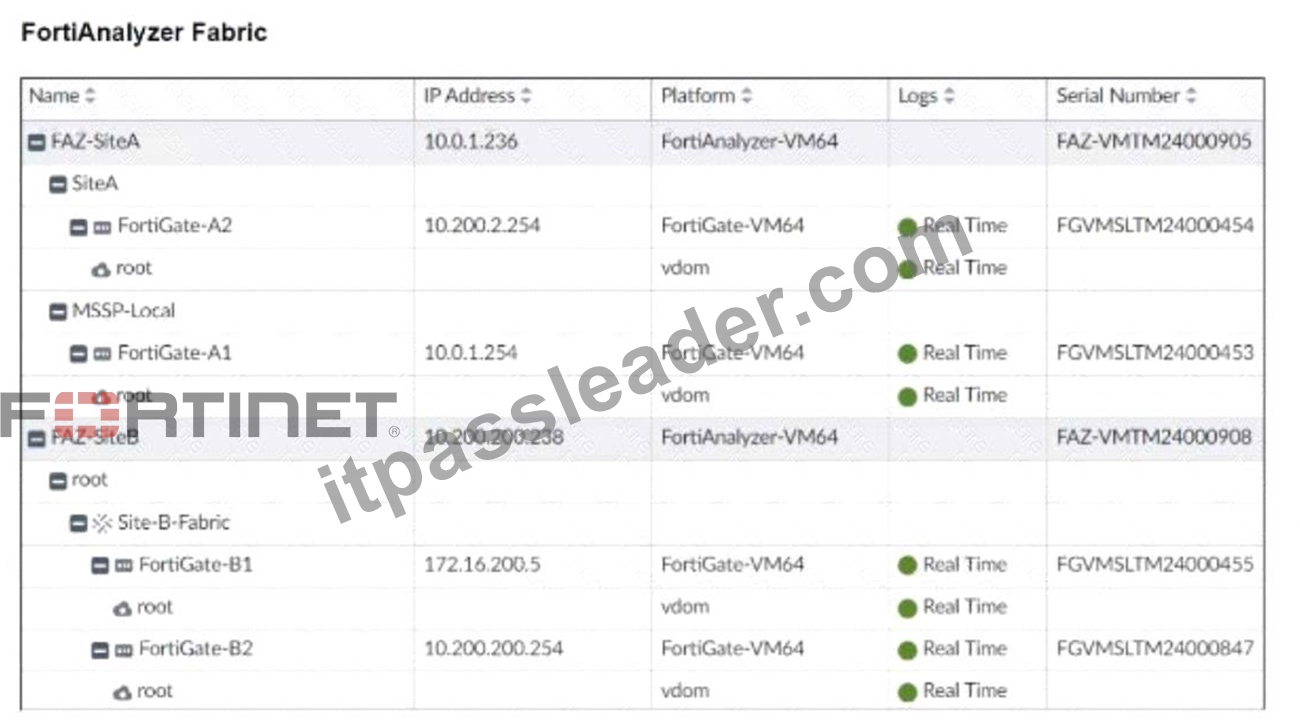
Assume that all devices in the FortiAnalyzer Fabric are shown in the image.
Which two statements about the FortiAnalyzer Fabric deployment are true? (Choose two.)
- A. All FortiGate devices are directly registered to the supervisor.
- B. FortiGate-B1 and FortiGate-B2 are in a Security Fabric.
- C. FAZ-SiteA has two ADOMs enabled.
- D. There is no collector in the topology.
Answer: B,C
Explanation:
* Understanding the FortiAnalyzer Fabric:
* The FortiAnalyzer Fabric provides centralized log collection, analysis, and reporting for connected FortiGate devices.
* Devices in a FortiAnalyzer Fabric can be organized into different Administrative Domains (ADOMs) to separate logs and management.
* Analyzing the Exhibit:
* FAZ-SiteAandFAZ-SiteBare FortiAnalyzer devices in the fabric.
* FortiGate-B1andFortiGate-B2are shown under theSite-B-Fabric, indicating they are part of the same Security Fabric.
* FAZ-SiteAhas multiple entries under it:SiteAandMSSP-Local, suggesting multiple ADOMs are enabled.
* Evaluating the Options:
* Option A:FortiGate-B1 and FortiGate-B2 are underSite-B-Fabric, indicating they are indeed part of the same Security Fabric.
* Option B:The presence of FAZ-SiteA and FAZ-SiteB as FortiAnalyzers does not preclude the existence of collectors. However, there is no explicit mention of a separate collector role in the exhibit.
* Option C:Not all FortiGate devices are directly registered to the supervisor. The exhibit shows hierarchical organization under different sites and ADOMs.
* Option D:The multiple entries underFAZ-SiteA(SiteA and MSSP-Local) indicate that FAZ-SiteA has two ADOMs enabled.
* Conclusion:
* FortiGate-B1 and FortiGate-B2 are in a Security Fabric.
* FAZ-SiteA has two ADOMs enabled.
References:
* Fortinet Documentation on FortiAnalyzer Fabric Topology and ADOM Configuration.
* Best Practices for Security Fabric Deployment with FortiAnalyzer.
NEW QUESTION # 54
Refer to the exhibits.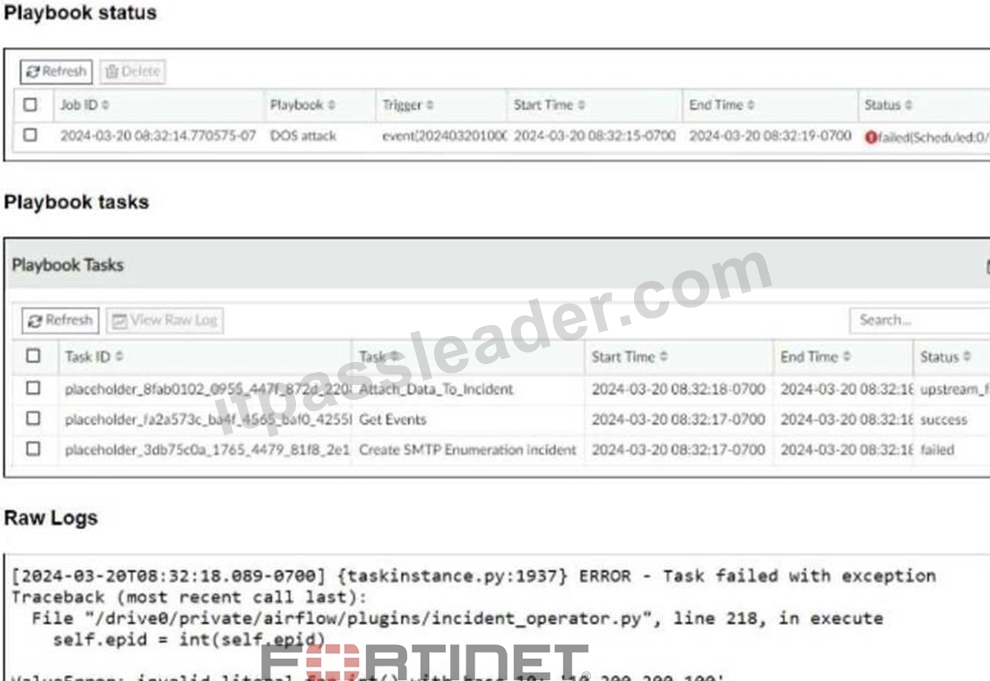
The DOS attack playbook is configured to create an incident when an event handler generates a denial-of-ser/ice (DoS) attack event.
Why did the DOS attack playbook fail to execute?
- A. The Create SMTP Enumeration incident task is expecting an integer value but is receiving the incorrect data type
- B. The Attach_Data_To_lncident task failed.
- C. The Get Events task is configured to execute in the incorrect order.
- D. The Attach_Data_To_lncident task is expecting an integer value but is receiving the incorrect datatype.
Answer: A
Explanation:
Understanding the Playbook and its Components:
The exhibit shows the status of a playbook named "DOS attack" and its associated tasks. The playbook is designed to execute a series of tasks upon detecting a DoS attack event. Analysis of Playbook Tasks:
Attach_Data_To_Incident: Task ID placeholder_8fab0102, status is "upstream_failed," meaning it did not execute properly due to a previous task's failure.
Get Events: Task ID placeholder_fa2a573c, status is "success."
Create SMTP Enumeration incident: Task ID placeholder_3db75c0a, status is "failed." Reviewing Raw Logs:
The error log shows a ValueError: invalid literal for int() with base 10: '10.200.200.100'.
This error indicates that the task attempted to convert a string (the IP address '10.200.200.100') to an integer, which is not possible.
Identifying the Source of the Error:
The error occurs in the file "incident_operator.py," specifically in the execute method.
This suggests that the task "Create SMTP Enumeration incident" is the one causing the issue because it failed to process the data type correctly.
Conclusion:
The failure of the playbook is due to the "Create SMTP Enumeration incident" task receiving a string value (an IP address) when it expects an integer value. This mismatch in data types leads to the error.
Reference: Fortinet Documentation on Playbook and Task Configuration.
Python error handling documentation for understanding ValueError.
NEW QUESTION # 55
Configuring playbook triggers correctly is crucial for which aspect of SOC automation?
- A. Increasing the manual tasks in the SOC
- B. Making sure that SOC analysts are kept busy
- C. Automating responses to detected incidents based on predefined conditions
- D. Ensuring that all security incidents receive a human response
Answer: C
NEW QUESTION # 56
When does FortiAnalyzer generate an event?
- A. When a log matches an action in a connector
- B. When a log matches a task in a playbook
- C. When a log matches a filter in a data selector
- D. When a log matches a rule in an event handler
Answer: D
Explanation:
Understanding Event Generation in FortiAnalyzer:
FortiAnalyzer generates events based on predefined rules and conditions to help in monitoring and responding to security incidents.
Analyzing the Options:
Option A: Data selectors filter logs based on specific criteria but do not generate events on their own.
Option B: Connectors facilitate integrations with other systems but do not generate events based on log matches.
Option C: Event handlers are configured with rules that define the conditions under which events are generated. When a log matches a rule in an event handler, FortiAnalyzer generates an event.
Option D: Tasks in playbooks execute actions based on predefined workflows but do not directly generate events based on log matches.
Conclusion:
FortiAnalyzer generates an event when a log matches a rule in an event handler.
Reference: Fortinet Documentation on Event Handlers and Event Generation in FortiAnalyzer.
Best Practices for Configuring Event Handlers in FortiAnalyzer.
NEW QUESTION # 57
How do playbook templates benefit SOC operations?
- A. By providing standardized responses to common security scenarios
- B. By serving as a decorative element in the SOC
- C. By reducing the need for IT personnel
- D. By increasing the complexity of incident response
Answer: A
NEW QUESTION # 58
......
Last FCSS_SOC_AN-7.4 practice test reviews: Practice Test Fortinet dumps: https://exam-labs.itpassleader.com/Fortinet/FCSS_SOC_AN-7.4-dumps-pass-exam.html