

Pass Your Fortinet NSE 6 NSE6_WCS-7.0 Exam Easily with Accurate PDF Questions [Sep 08, 2025]
NSE6_WCS-7.0 Certification Exam Dumps Questions in here
Fortinet NSE6_WCS-7.0 Exam is a must-have certification for people who work with AWS cloud infrastructures to ensure their security, compliance, and governance. The Exam focuses on the implementation of Security and Designing of AWS deployments, along with the implementation of best practices for securing AWS workloads. The Fortinet NSE6_WCS-7.0 Exam validates the knowledge and skills to identify and mitigate risks, understand threat management, and implement security controls and automation techniques in the cloud environment.
NEW QUESTION # 13
Refer to the exhibit.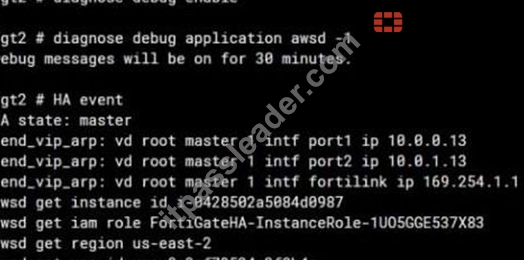
You deployed an active-passive FortiGate HA using a Cloud Formation template on an existing VPC_Now you want to test active-passive FortiGate HA failover by running a debug so you can see the API calls to change the elastic and secondary IP addresses.
Which statement is correct about the output of the debug?
- A. IP address 10. O. O. L 3 is now associated with eni-Ob61d8afcOaefb8a2.
- B. The elastic IP is associated with port1of Fgt2.
- C. The elastic IP is associated with port2 of Fgt2. and the secondary IP address for port1and port2 was updated successfully.
- D. The routing table for Fgt2 updated successfully. and port2 will provide internet access to Fgt2.
Answer: A
NEW QUESTION # 14
Refer to the exhibit.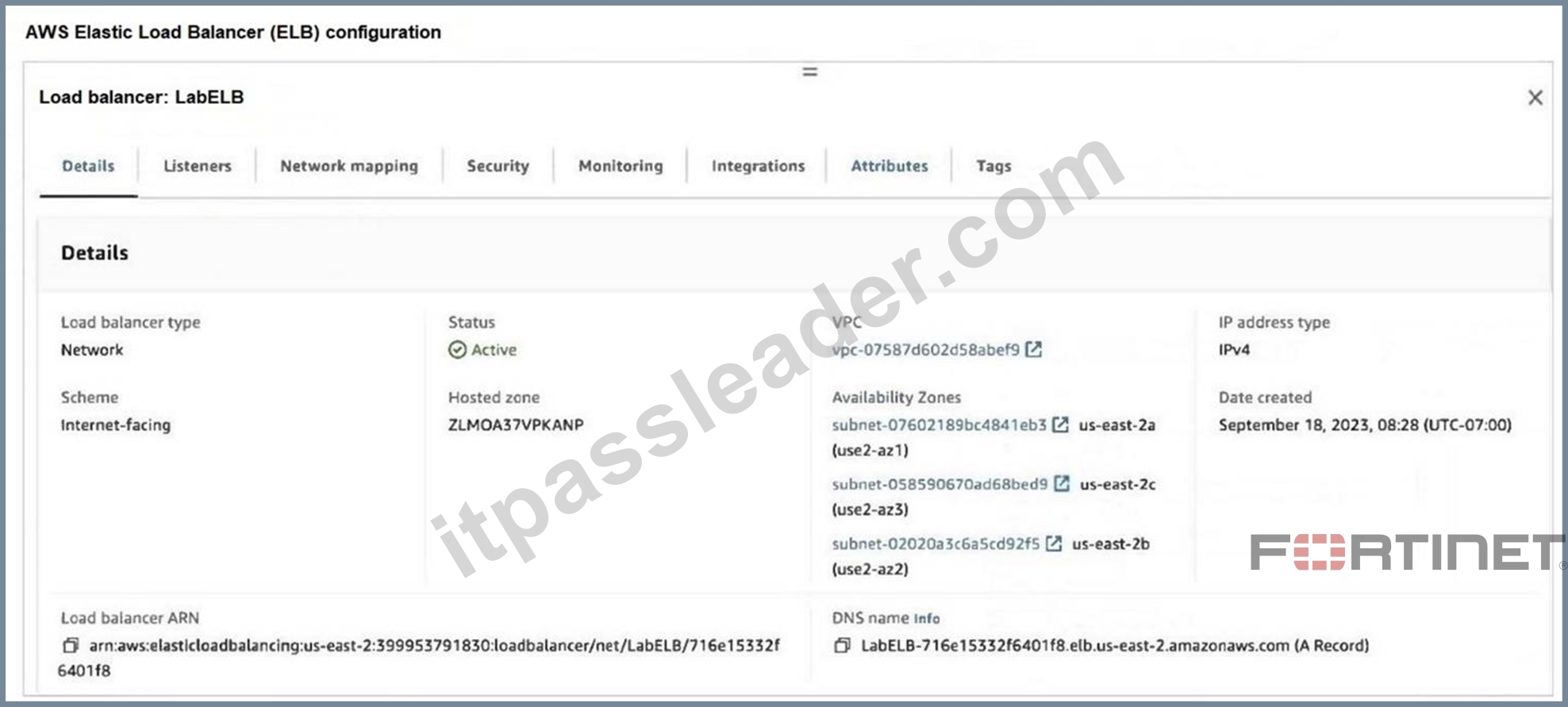
A customer is using the AWS Elastic Load Balancer (ELB).
Which two statements are correct about the ELB configuration? (Choose two.)
- A. You can use the DNS name to reach the targets behind the ELB.
- B. The Amazon Resource Name is used to access the load balancer node and targets.
- C. The load balancer is configured for the internal traffic of the virtual public cloud (VPC).
- D. The load balancer is configured to load balance traffic among multiple availability zones.
Answer: A,D
Explanation:
* Load Balancer Configuration Overview:
* The provided configuration indicates that the ELB is an internet-facing load balancer.
* Multi-AZ Load Balancing:
* The load balancer is configured to distribute traffic across multiple availability zones (A, B, and C), ensuring high availability and fault tolerance (Option A).
* Accessing Targets via DNS:
* The DNS name of the load balancer (LabELB-716e15332f6401f8.elb.us-east-2.amazonaws.com) can be used to reach the targets behind the ELB, facilitating traffic routing to the appropriate instances (Option C).
* Comparison with Other Options:
* Option B is incorrect as the ARN is not used to access the load balancer directly.
* Option D is incorrect because the load balancer is configured for internet-facing traffic, not just internal VPC traffic.
References:
* AWS Elastic Load Balancer Documentation: AWS ELB
* Understanding ELB DNS: AWS ELB DNS
NEW QUESTION # 15
Refer to the exhibit.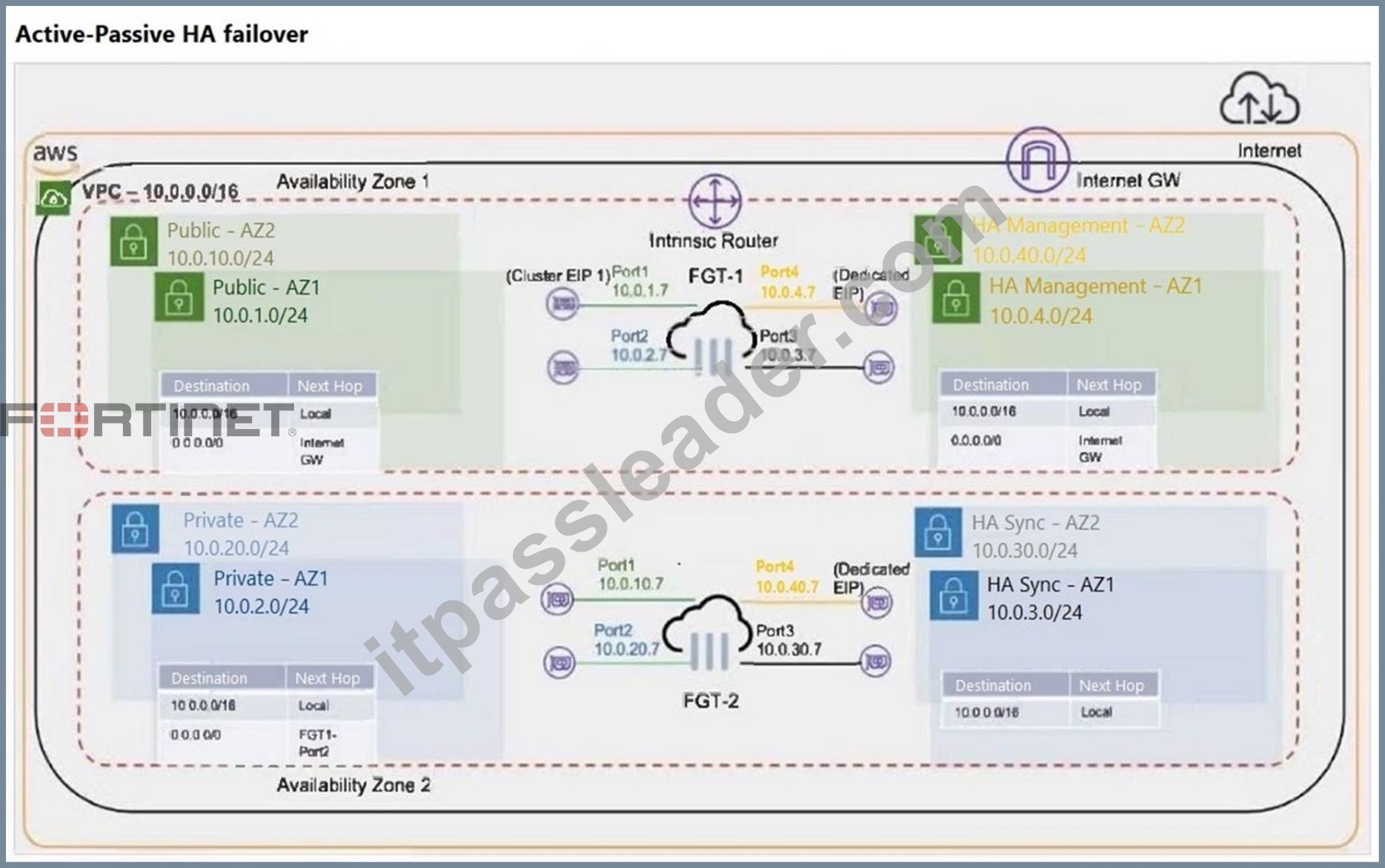
What occurs during a failover for an active-passive (A-P) cluster that is deployed in two different availability zones? (Choose two.)
- A. The cluster elastic IP address (EIP) is moved from Port1 of FGT-1 to Port1 of FGT-2.
- B. The default static route in the Private-AZ1 subnet route table is modified to forward all traffic to Port2 of FGT2.
- C. The secondary IP address of Port2 of FGT-1 is moved to Port2 of FGT-2.
- D. An additional route is added to the route table of the HA Sync AZ2 subnet to forward all traffic to the Internet GW.
Answer: A,C
Explanation:
* Cluster Elastic IP Address (EIP) Movement:
* During a failover in an active-passive (A-P) cluster, the Elastic IP (EIP) associated with the active FortiGate instance (FGT-1) needs to be moved to the passive instance (FGT-2), which becomes the new active instance. This ensures that the traffic directed to the EIP is now handled by FGT-2 (Option A).
* Secondary IP Address Movement:
* The secondary IP address on Port2 of the current active instance (FGT-1) is moved to the same port on the new active instance (FGT-2). This step is crucial to ensure seamless network traffic redirection and connectivity for the services relying on that IP address (Option B).
* Other Options Analysis:
* Option C is incorrect because the static route modification mentioned is not directly related to the failover process described.
* Option D is incorrect because no additional route needs to be added to the HA Sync AZ2 subnet route table to forward traffic to the Internet Gateway during a failover.
References:
* FortiGate HA Configuration Guide: FortiGate HA
* AWS Elastic IP Documentation: Elastic IP
NEW QUESTION # 16
A global organization with cloud networks deployed in several AWS regions wants to set up next-generation firewall (NGFW) protection using FortiGate Cloud-Native Firewall (CNF).
What are two deployment considerations for the organization? (Choose two.)
- A. Only one CNF instance is required to protect all AWS regions.
- B. They must choose AWS Firewall Manager to provision a CNF instance.
- C. A CNF instance is required for each AWS region that must be protected.
- D. More than one AWS account can be associated with a CNF instance.
Answer: C,D
NEW QUESTION # 17
An organization has created a VPC with two subnets and deployed a FortiGate-VM (VM04/c4.xlarge) in AWS.
The EC2 instance is initially configured with two Elastic Network Interfaces (ENIs). The primary ENI is configured on the public subnet, and the secondary ENI is configured on the private subnet. To provide internet access for the FortiGate-VM, they now want to associate an EIP to its primary ENI, but the assignment is failing.
Which action would allow the EIP assignment to be successful?
- A. Shut down the FortiGate VM, if it is running, assign the EIP to the primary ENI, and then power it on.
- B. Create and attach an internet gateway to the VPC, and then assign the EIP to the primary ENI of the FortiGate VM.
- C. Create and attach a public routing table to the public subnet, associate the public subnet with the primary ENI of the FortiGate VM, and then assign the EIP to the primary ENI.
- D. Create and associate a public subnet with the primary ENI of the FortiGate VM, and then assign the EIP to the primary ENI.
Answer: B
Explanation:
* Internet Gateway Requirement:
* For an Elastic IP (EIP) to be assigned to an instance's primary ENI, the VPC must have an Internet Gateway (IGW) attached. The IGW enables the VPC to communicate with the internet, allowing the EIP to function properly (Option C).
* Process of Assigning EIP:
* Once the Internet Gateway is attached to the VPC, the EIP can be successfully assigned to the primary ENI of the FortiGate VM, providing it with internet access.
* Other Options Analysis:
* Option A is incorrect because the primary ENI is already in a public subnet.
* Option B is not necessary and may not solve the issue without an attached Internet Gateway.
* Option D is partially correct about the routing table but does not address the primary issue of needing an Internet Gateway.
References:
* AWS Elastic IP Documentation: Elastic IP
* AWS Internet Gateway: Internet Gateway
NEW QUESTION # 18
An administrator has deployed an environment in AWS and is now trying to send outbound traffic from the web servers to the internet through FortiGate. The FortiGate policies are configured to allow all outbound traffic. however. the traffic is not reaching the FortiGate internal interface.
Which two statements Can be the reasons for this behavior? (Choose two)
- A. AWS security groups are blocking the traffic.
- B. AWS source destination checks are enabled on the FortiGate internal interfaces.
- C. FortiGate is not configured as a default gateway tor web servers.
- D. Internet Gateway (IGW) is not configured for VPC.
Answer: A,B
NEW QUESTION # 19
An administrator must deploy a web application firewall (WAF) solution to protect the web applications of their organization.
Why would the administrator choose FortiWeb Cloud over AWS WAF with Fortinet managed rules?
- A. SSL inspection is a requirement.
- B. Traffic must be inspected for malware.
- C. WAF signatures must be manually updated by FortiGuard.
- D. The solution must meet PCI 6.6 compliance.
Answer: A
Explanation:
* SSL Inspection Requirement:
* FortiWeb Cloud provides comprehensive SSL inspection capabilities, allowing it to decrypt and inspect HTTPS traffic for threats. This is a crucial feature for many organizations that need to ensure all traffic, including encrypted traffic, is thoroughly inspected (Option C).
* Comparison with AWS WAF:
* While AWS WAF with Fortinet managed rules provides robust protection, it might not offer the same level of SSL inspection capabilities as FortiWeb Cloud.
* Other Considerations:
* Option A (Manual WAF signature updates) is incorrect because FortiWeb Cloud updates signatures automatically.
* Option B (PCI 6.6 compliance) is a general requirement for any WAF solution, not specific to choosing FortiWeb Cloud over AWS WAF.
* Option D (Traffic inspection for malware) is a feature provided by both FortiWeb Cloud and AWS WAF with Fortinet managed rules.
References:
* FortiWeb Cloud Overview: FortiWeb Cloud
* AWS WAF Documentation: AWS WAF
NEW QUESTION # 20
Which three statements are correct about VPC flow (Choose three.)
- A. Flow logs can capture traffic to the reserved IP address for the default VPC router.
- B. Flow logs do not capture traffic to andfrom169.2 54 .169.254 for instance metadata.
- C. Flow logs can be used as a security tool to monitor the traffic that is reaching the instance.
- D. Flow logs can capture real-time log streams for the network interfaces.
- E. Flow logs do not capture DHCP traffic.
Answer: B,C,E
NEW QUESTION # 21
What is the purpose of the created as part Of a FortiGate autoscale deployment using Fortinet cloud formation template in AWS?
- A. To store information about varying states of auto scaling conditions.
- B. To store the traffic logs Of all FortiGates.
- C. To Store the information used for the scale set.
- D. To store the firewall policies used by all FortiGates_
Answer: A
NEW QUESTION # 22
Which three statements are correct about AWS security groups? (Choose three)
- A. a Security group rules are always permissive: you cannot create rules that deny access.
- B. When associate multiple security groups With an instance, the rules from each security group are effectively aggregated to create one set Of rules
- C. By default, security groups block all outbound traffic.
- D. Security groups are statetul
- E. By default,security groups allow all inbound traffic.
Answer: A,B,D
NEW QUESTION # 23
Refer to the exhibit.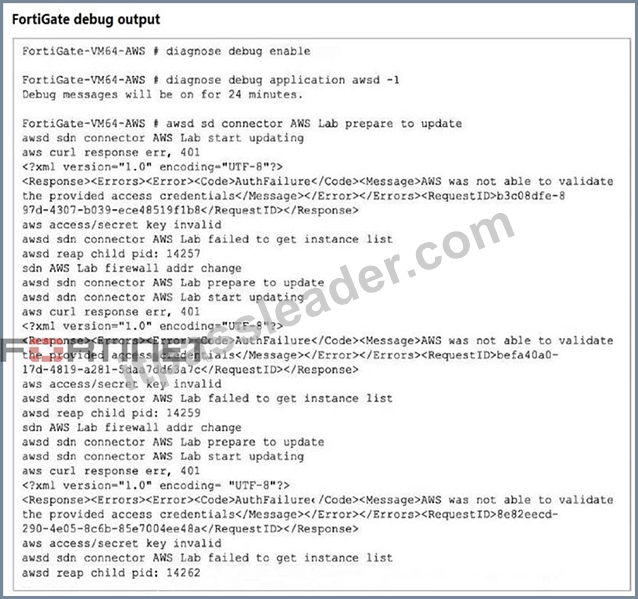
An administrator configured a FortiGate device to connect to the AWS API to retrieve resource values from the AWS console to create dynamic objects for the FortiGate policies. The administrator is unable to retrieve AWS dynamic objects on FortiGate.
Which two reasons can explain why? (Choose two.)
- A. AWS was not able to validate credentials provided by the AWS Lab SDN connector because of a clock skew between FortiGate and AWS.
- B. The AWS Lab SDN did not find any instances in the configured VPC.
- C. The AWS API call is not supported on XML version 1.0.
- D. The AWS Lab SDN connector is configured with an invalid AWS access or secret key.
- E. The AWS Lab SDN connector failed to connect on port 401.
Answer: A,D
Explanation:
* Invalid Credentials:
* The debug output shows an "AuthFailure" error, indicating that AWS was not able to validate the provided access credentials. This usually points to incorrect or invalid AWS access or secret keys configured in the AWS Lab SDN connector (Option C).
* Clock Skew:
* Another common reason for authentication failures in AWS API calls is a clock skew between the FortiGate device and AWS. AWS requires that the system time of the client making the API call is synchronized with its own time, within a small margin. If there is a significant time difference, AWS will reject the credentials (Option B).
* Other Options Analysis:
* Option A is incorrect because the AWS API supports XML version 1.0.
* Option D is incorrect as the error message does not indicate an issue with connecting on port 401.
* Option E is incorrect because the error is related to authentication, not the absence of instances.
References:
* AWS API Authentication: AWS API Security
* FortiGate AWS Integration Guide: FortiGate AWS Integration
NEW QUESTION # 24
A customer is attempting to deploy an active-passive high availability (HA) cluster using the software-defined network (SDN) connector in the AWS cloud.
What is an important consideration to ensure a successful formation of HA, failover, and traffic flow?
- A. Unicast FortiGate Clustering Protocol (FGCP) must be used.
- B. Both cluster members must be in the same availability zone.
- C. VDOM exceptions must be configured.
- D. Both cluster members must show as healthy in the elastic load balancer (ELB) configuration.
Answer: A
Explanation:
* HA Cluster in AWS Cloud:
* Deploying an active-passive HA cluster in AWS requires careful consideration of the clustering protocol used to ensure seamless failover and traffic flow.
* Unicast FortiGate Clustering Protocol (FGCP):
* Unicast FGCP is specifically designed for environments where multicast traffic is not feasible or supported, such as in the AWS cloud. Using unicast FGCP ensures that heartbeat and synchronization traffic between the cluster members are managed correctly over unicast communication, which is suitable for AWS's network infrastructure (Option C).
* Comparison with Other Options:
* Option A is incorrect because while placing both cluster members in the same availability zone might be required for certain configurations, it is not the critical factor for HA formation.
* Option B is incorrect as VDOM exceptions are not directly related to the successful formation of HA.
* Option D is incorrect because the ELB configuration checks are more about ensuring that the load balancer correctly routes traffic but do not specifically ensure HA formation and failover.
References:
* FortiGate HA in AWS Documentation: FortiGate HA
* Fortinet FGCP Details: FGCP Documentation
NEW QUESTION # 25
AWS native network services offer vast functionality and inter-connectivity between the cloud and on- premises networks.
Which three additional functions can FortiGate for AWS offer to complement the native services offered by AWS? (Choose three.)
- A. OSPF over IPSec
- B. Advanced dynamic routing
- C. Secure SD-WAN with application visibility
- D. Web filtering
- E. Higher VPN throughput
Answer: A,C,D
Explanation:
* Web Filtering:
* FortiGate for AWS offers advanced web filtering capabilities, which allow organizations to control and monitor web access. This feature complements AWS's native security services by providing granular control over web traffic (Option B).
* OSPF over IPSec:
* FortiGate for AWS can establish dynamic routing protocols such as OSPF (Open Shortest Path First) over IPSec tunnels. This capability enhances network routing flexibility and security, which is not natively provided by AWS (Option C).
* Secure SD-WAN with Application Visibility:
* FortiGate for AWS provides Secure SD-WAN functionality, offering enhanced application visibility and traffic management. This is a significant addition to AWS's networking services, optimizing application performance and security (Option E).
* Comparison with Other Options:
* Option A (Higher VPN throughput) is not specifically enhanced by FortiGate as compared to AWS native services.
* Option D (Advanced dynamic routing) is partially covered under OSPF over IPSec but is not as specific as the other chosen options.
References:
* FortiGate for AWS Documentation: FortiGate on AWS
* AWS Networking and Content Delivery: AWS Networking
NEW QUESTION # 26
An administrator is adding a web application to be protected by FortiWeb Cloud.
Which two steps are necessary to successfully onboard the application? (Choose two.) An administrator is adding a web application to be protected by FortiWeb Cloud.
Which two steps are necessary to successfully onboard the application? (Choose two.)
- A. Enable a content delivery network (CDN) in the same region where your application is located.
- B. Provide a web application name.
- C. Create DNS records in the domain server that hosts the application.
- D. Wait for the EC2 instance to be created.
Answer: B,C
Explanation:
* Web Application Name:
* When onboarding a web application to be protected by FortiWeb Cloud, you need to provide a name for the web application. This helps in identifying and managing the application within the FortiWeb Cloud console (Option B).
* DNS Records:
* To ensure that traffic to your web application is correctly routed through FortiWeb Cloud, you must create DNS records in the domain server that hosts your application. This ensures that requests are directed to FortiWeb Cloud for inspection and protection (Option C).
* Other Considerations:
* Option A (Waiting for the EC2 instance) is incorrect as it is not a necessary step for onboarding a web application to FortiWeb Cloud.
* Option D (Enabling a CDN) is not a mandatory step for onboarding but can be part of a broader strategy for improving performance and protection.
References:
* FortiWeb Cloud Documentation: FortiWeb Cloud
NEW QUESTION # 27
Refer to the exhibit.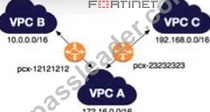
Which statement is correct about the VPC peering connections shown in the exhibit?
- A. TO route packets directly from VPC B to VPC C through VPC A, you must add a route for network 192.168.0.0/16 in the VPC A routing table.
- B. You cannot route packets directly from VPC B to VPC C through VPC A.
- C. You can associate VPC ID pcx-23232323 with VPC B to form a VPC peering connection between VPC B and VPC C.
- D. You cannot create a VPC peering connection between VPC B and VPC C to route packets directly.
Answer: B
NEW QUESTION # 28
Your company deployed a FortiSandbox for AWS.
Which statement is correct about FortiSandbox for AWS?
- A. FortiSandbox for AWS does not need more resources because it performs only management and analysis tasks.
- B. The FortiSandbox manager is installed on the AWS platform and analyzes the results of the sandboxing process received from on-premises Windows instances.
- C. FortiSandbox for AWS comes as a hybrid solution. The FortiSandbox manager is installed on-premises and analyzes the results of the sandboxing process received from AWS EC2 instances.
- D. FortiSandbox deploys new EC2 instances with the custom Windows and Linux VMs, then it sends malware, runs it, and captures the results for analysis.
Answer: D
Explanation:
* FortiSandbox Deployment:
* FortiSandbox for AWS deploys new EC2 instances to create isolated environments where it can safely execute and analyze suspicious files. These instances run custom Windows and Linux virtual machines specifically configured for sandboxing (Option D).
* Sandboxing Process:
* The process involves sending potential malware to these isolated VMs, executing it, and monitoring its behavior to detect malicious activities. The results are then captured and analyzed to provide detailed threat intelligence.
* Other Options Analysis:
* Option A is incorrect because FortiSandbox for AWS operates entirely within the AWS environment and does not require an on-premises manager.
* Option B is incorrect as the FortiSandbox manager is not installed on the AWS platform for managing on-premises instances.
* Option C is incorrect because FortiSandbox requires sufficient resources to perform the actual sandboxing and analysis tasks.
References:
* FortiSandbox for AWS Documentation: FortiSandbox
* Sandboxing Concepts: Sandboxing
NEW QUESTION # 29
Which product you Can use as AWS WAF web access control lists (web ACLS) to minimize the effects Of a DDOS attack?
- A. AWS Protector
- B. AWS Inspector
- C. AWS GuardDuty
- D. AWS Shield
Answer: D
NEW QUESTION # 30
......
Updated NSE6_WCS-7.0 Exam Practice Test Questions: https://exam-labs.itpassleader.com/Fortinet/NSE6_WCS-7.0-dumps-pass-exam.html