

PSE-Cortex Professional PSE-Cortex-Pro-24 Dumps Full Questions with Free PDF Questions to Pass
100% Updated Palo Alto Networks PSE-Cortex-Pro-24 Enterprise PDF Dumps
NEW QUESTION # 63
What is the requirement for enablement of endpoint and network analytics in Cortex XDR?
- A. Windows DHCP logs ingested via a Cortex XDR collector
- B. Network Mapper applet on the Broker VM configured and enabled
- C. Logs from at least 30 endpoints over a minimum of two weeks
- D. Cloud Identity Engine configured and enabled
Answer: B
NEW QUESTION # 64
During the TMS instance activation, a tenant (Customer) provides the following information for the fields in the Activation - Step 2 of 2 window.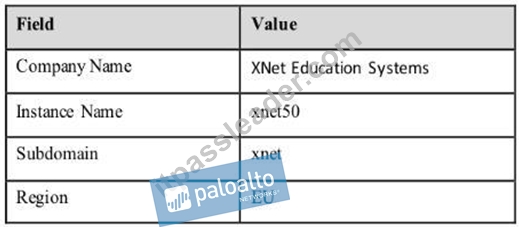
During the service instance provisioning which three DNS host names are created? (Choose three.)
- A. cc.xnet50traps.paloaltonetworks.com
- B. cc-xnet.traps.paloaltonetworks.com
- C. xnettraps.paloaltonetworks.com
- D. ch-xnet.traps.paloaltonetworks.com
- E. hc-xnet50.traps.paloaltonetworks.com
- F. cc-xnet50.traps.paloaltonetworks.com
Answer: B,D,F
NEW QUESTION # 65
Why is reputation scoring important in the Threat Intelligence Module of Cortex XSOAR?
- A. It deconflicts prioritization when two vendors give different scores for the same indicator.
- B. It provides a mathematical model for combining scores from multiple vendors.
- C. It allows for easy comparison between open-source intelligence and paid services.
- D. It helps identify threat intelligence vendors with substandard content.
Answer: A
Explanation:
Reference: https://www.paloaltonetworks.com/resources/datasheets/cortex-xsoar-threat-intelligence- management
NEW QUESTION # 66
The images show two versions of the same automation script and the results they produce when executed in Demisto. What are two possible causes of the exception thrown in the second Image? (Choose two.) SUCCESS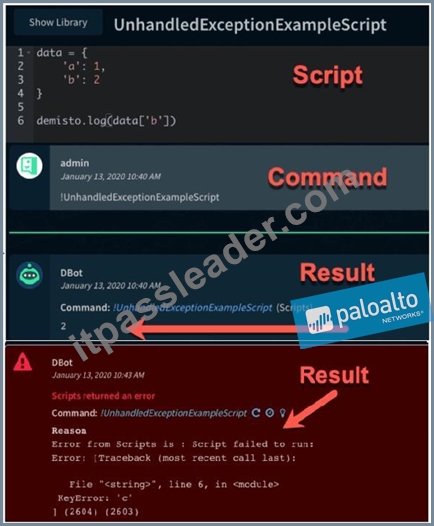
- A. The modified script required a different parameter to run successfully.
- B. The modified script attempted to access a dictionary key that did not exist in the dictionary named
"data" - C. The dictionary was defined incorrectly in the second script.
- D. The modified scnpt was run in the wrong Docker image
Answer: D
NEW QUESTION # 67
What are the key capabilities of the ASM for Remote Workers module?
- A. Identifying office network vulnerabilities, monitoring remote workforce, and encrypting data
- B. Analyzing global scan data, identifying risky issues on remote networks, and providing internal insights
- C. Monitoring endpoint activity, managing firewall rules, and mitigating cybersecurity threats
- D. Gathering endpoint data, conducting internal scans, and automating network configurations
Answer: B
Explanation:
The ASM for Remote Workers module in Cortex Xpanse focuses on analyzing global scan data, identifying risky issues on remote networks, and providing internal insights. This helps organizations maintain visibility and control over the security of their remote workforce, ensuring that potential risks and vulnerabilities in remote network configurations are addressed proactively.
NEW QUESTION # 68
Approximately how many Cortex XSOAR marketplace integrations exist?
- A. Between 700-2000
- B. Between 400-700
- C. Over 2000
- D. Between 1-400
Answer: A
Explanation:
There are between 700-2000 integrations available on the Cortex XSOAR marketplace. This extensive range of integrations allows users to connect with various third-party applications, services, and tools, helping to automate and streamline security operations.
NEW QUESTION # 69
If you have a playbook task that errors out. where could you see the output of the task?
- A. War Room of the incident
- B. Demisto Audit log
- C. Playbook Editor
- D. /var/log/messages
Answer: A
NEW QUESTION # 70
A customer has purchased Cortex Data Lake storage with the following configuration, which requires 2 TB of Cortex Data Lake to order:
support for 300 total Cortex XDR clients all forwarding Cortex XDR data with 30-day retention storage for higher fidelity logs to support Cortex XDR advanced analytics The customer now needs 1000 total Cortex XDR clients, but continues with 300 clients forwarding Cortex XDR data with 30-day retention.
What is the new total storage requirement for Cortex Data Lake storage to order?
- A. 8 TB
- B. 16 TB
- C. 4 TB
- D. 2 TB
Answer: D
Explanation:
Cortex Data Lake (now known as Strata Logging Service in some contexts, but still referred to as Cortex Data Lake for XDR purposes) is the cloud-based storage solution that supports Cortex XDR by storing endpoint telemetry, logs, and analytics data. The customer's storage needs depend on the number of Cortex XDR clients, the subset forwarding data, the retention period, and the type of data stored (e.g., higher fidelity logs for advanced analytics). Let's break down the problem step-by-step to determine the new storage requirement.
Initial Configuration:
* Total Cortex XDR Clients: 300
* Clients Forwarding Cortex XDR Data: 300 (all clients are forwarding data)
* Retention Period: 30 days
* Additional Requirement: Storage for higher fidelity logs to support Cortex XDR advanced analytics
* Initial Storage Ordered: 2 TB
This configuration implies that 2 TB was sufficient to support 300 clients, all forwarding data, with a 30-day retention period, including the additional storage needed for advanced analytics logs.
New Configuration:
* Total Cortex XDR Clients: 1,000
* Clients Forwarding Cortex XDR Data: 300 (unchanged from the initial setup)
* Retention Period: 30 days (unchanged)
* Additional Requirement: Storage for higher fidelity logs to support Cortex XDR advanced analytics (unchanged) The key change is the increase in total Cortex XDR clients from 300 to 1,000, but the number of clients forwarding data remains 300, and the retention period and analytics requirements are unchanged. We need to determine how this affects the storage requirement.
Cortex Data Lake Storage Sizing for Cortex XDR:
Palo Alto Networks provides sizing guidelines for Cortex Data Lake based on the number of endpoints forwarding data, the retention period, and the type of data stored. The storage requirement is primarily driven by:
* Clients Forwarding Data: Only the endpoints actively sending telemetry to Cortex Data Lake (e.g., Cortex XDR Pro endpoints with enhanced data collection) contribute significantly to storage needs.
* Retention Period: The number of days data is retained directly scales the storage requirement.
* Data Type: Higher fidelity logs for advanced analytics (e.g., XDR Pro features like behavioral analytics) increase storage per endpoint compared to basic logs.
* Cortex XDR Prevent: Provides basic endpoint protection with minimal data forwarding (e.g., alerts only), typically included in a 30-day retention baseline with minimal storage impact.
* Cortex XDR Pro: Includes enhanced endpoint data collection (e.g., process execution, network activity) for advanced analytics, significantly increasing storage needs when enabled.
The problem states that all 300 initial clients were forwarding data, and the same 300 continue to do so in the new setup, with support for advanced analytics. This suggests these are likely Cortex XDR Pro clients, as Pro is required for full telemetry and analytics capabilities.
Storage Calculation:
Palo Alto Networks doesn't publish exact per-endpoint storage figures publicly, but we can infer the requirement from the initial configuration and industry benchmarks:
* Initial Setup (300 Clients, 30 Days, 2 TB):
* 2 TB supports 300 clients forwarding data for 30 days with advanced analytics.
* Per client, this approximates to:2 TB÷300 clients=0.00667 TB/client2 \, \text{TB} \div 300 \, \text
{clients} = 0.00667 \, \text{TB/client} 2TB÷300clients=0.00667TB/client or 6.67 GB per client for 30 days with higher fidelity logs.
* This aligns with typical XDR Pro storage estimates, where enhanced data collection (e.g., 5-10 GB per endpoint per 30 days) is common depending on activity levels and analytics features.
* New Setup (1,000 Total Clients, 300 Forwarding, 30 Days):
* Clients Forwarding Data: Still 300, unchanged.
* Retention: Still 30 days, unchanged.
* Analytics Logs: Still required, unchanged.
* Storage is driven by the 300 clients forwarding data, not the total number of clients. The additional 700 clients (1,000 - 300 = 700) are not forwarding data, suggesting they might be on Cortex XDR Prevent licenses or not fully activated for data collection, contributing negligible storage (e.g., only alerts, which are minimal).
Thus, the storage requirement remains:
300clients×6.67GB/client=2,001GB#2TB
References:
Cortex XDR Documentation: Indicates that storage is calculated based on endpoints with data collection enabled, not total agents (e.g., docs-cortex.paloaltonetworks.com).
Cortex Data Lake Sizing: Palo Alto's sizing tools (e.g., Strata Logging Service Estimator) emphasize active data sources and retention, not total licenses.
Industry Norms: XDR solutions typically require 5-15 GB per endpoint per 30 days for advanced analytics, consistent with the 2 TB for 300 clients.
NEW QUESTION # 71
Which two filter operators are available in Cortex XDR? (Choose two.)
- A. < >
- B. not Contains
- C. !*
- D. =>
Answer: B,C
Explanation:
https://docs.paloaltonetworks.com/cortex/cortex-xdr/cortex-xdr-pro-admin/get-started-with-cortex-xdr-pro
/use-cortex-xdr/manage-tables.html
NEW QUESTION # 72
Which resource can a customer use to ensure that the Cortex XDR agent will operate correctly on their CentOS 07 servers?
- A. Release Notes
- B. Compatibility Matrix
- C. Administrator Guide
- D. LIVE community
Answer: B
Explanation:
A customer can use the Compatibility Matrix to ensure that the Cortex XDR agent will operate correctly on their CentOS 7 servers. The Compatibility Matrix provides detailed information on supported operating systems, versions, and other system requirements for the Cortex XDR agent.
NEW QUESTION # 73
Which feature of Cortex Xpanse allows it to identify previously unknown assets?
- A. Dynamic asset registration
- B. Active directory enumeration
- C. Scheduled network scanning
- D. Continuous internet scanning
Answer: D
Explanation:
Cortex Xpanse uses continuous internet scanning to identify previously unknown assets. This feature allows the platform to continuously monitor the internet for new or unregistered assets that could be associated with an organization's network, providing real-time visibility into potential exposure or vulnerabilities.
NEW QUESTION # 74
Which service helps uncover attackers wherever they hide by combining world-class threat hunters with Cortex XDR technology that runs on integrated endpoint, network, and cloud data sources?
- A. Cloud Identity Engine
- B. Threat Intelligence Platform (TIP)
- C. virtual desktop infrastructure (VDI)
- D. Managed Threat Hunting
Answer: D
Explanation:
Reference: https://www.paloaltonetworks.com/resources/techbriefs/cortex-xdr-managed-threat-hunting
NEW QUESTION # 75
Cortex XSOAR has extracted a malicious Internet Protocol (IP) address involved in command-and-control (C2) traffic.
What is the best method to block this IP from communicating with endpoints without requiring a configuration change on the firewall?
- A. Have XSOAR automatically add the IP address to a threat intelligence management (TIM) malicious IP list to elevate priority of future alerts.
- B. Have XSOAR automatically add the IP address to a deny rule in the firewall.
- C. Have XSOAR automatically create a NetOps ticket requesting a configuration change to the firewall to block the IP.
- D. Have XSOAR automatically add the IP address to an external dynamic list (EDL) used by the firewall.
Answer: D
NEW QUESTION # 76
Which consideration should be taken into account before deploying Cortex XSOAR?
- A. Which endpoint protection software to integrate with Cortex XSOAR
- B. Which cybersecurity framework to implement for Secure Operations Center (SOC) operations
- C. How to configure network firewalls for optimal performance
- D. Whether communication with internal or external applications is required
Answer: D
Explanation:
Before deploying Cortex XSOAR, it's important to consider whether communication with internal or external applications is required. This ensures that integrations and data flows between Cortex XSOAR and other tools or systems in the environment can be properly configured, enabling seamless automation and orchestration of security operations.
NEW QUESTION # 77
What is a benefit offered by Cortex XSOAR?
- A. It enables a comprehensive view of the customer environment with regard to digital employee productivity.
- B. It provides advanced customization capabilities.
- C. It enables consolidation of multiple point products into a single integrated service.
- D. It provides real-time protection across hosts and containers.
Answer: C
NEW QUESTION # 78
Which feature of Cortex XSIAM displays an entire picture of an attack, including the originating process or delivery point?
- A. Correlation rule
- B. Sample analysis
- C. Automation playbook
- D. Causality View
Answer: D
Explanation:
The Causality View in Cortex XSIAM provides an entire picture of an attack, including the originating process or delivery point. It allows security teams to visualize and understand the full sequence of events leading to an attack, helping to identify root causes and mitigate future risks.
NEW QUESTION # 79
An EDR project was initiated by a CISO. Which resource will likely have the most heavy influence on the project?
- A. operations manager
- B. SOC analyst IT
- C. desktop engineer
- D. SOC manager
Answer: D
NEW QUESTION # 80
What is the difference between an exception and an exclusion?
- A. An exception does not exist
- B. An exclusion does not exist
- C. An exclusion is based on rules and exceptions are based on alerts.
- D. An exception is based on rules and exclusions are on alerts
Answer: D
NEW QUESTION # 81
What is the recommended first step in planning a Cortex XDR deployment?
- A. Deploy Cortex XDR on endpoints with the highest potential for attack.
- B. Deploy agents across the entire environment for immediate protection.
- C. Implement Cortex XDR across all endpoints without assessing architecture or assets
- D. Conduct an assessment and identify critical assets and endpoint within the environment.
Answer: D
Explanation:
The recommended first step in planning a Cortex XDR deployment is to conduct an assessment and identify critical assets and endpoints within the environment. This ensures that the deployment is targeted and effective, focusing on the most critical parts of the infrastructure that are most likely to be attacked or compromised.
NEW QUESTION # 82
An adversary is attempting to communicate with malware running on your network for the purpose of controlling malware activities or for ex filtrating data from your network. Which Cortex XDR Analytics alert is this activity most likely to trigger'?
- A. Uncommon Local Scheduled Task Creation
- B. Malware
- C. New Administrative Behavior
- D. DNS Tunneling
Answer: D
NEW QUESTION # 83
......
Use Valid Exam PSE-Cortex-Pro-24 by ITPassLeader Books For Free Website: https://exam-labs.itpassleader.com/Palo-Alto-Networks/PSE-Cortex-Pro-24-dumps-pass-exam.html