

[Jun-2026] 400-007 Exam Dumps - Free Demo & 365 Day Updates
Free Sales Ending Soon - Use Real 400-007 PDF Questions
Cisco 400-007 is a highly sought-after certification exam that is designed for individuals who want to become Cisco Certified Design Experts (CCDE v3.0). 400-007 exam is designed to test the candidate's knowledge and skills in designing complex networks, providing solutions for network infrastructure, and implementing advanced technologies. Cisco Certified Design Expert (CCDE) Written Exam certification is widely recognized and respected in the networking industry, making it a valuable asset for any IT professional.
NEW QUESTION # 263
Refer to the exhibit.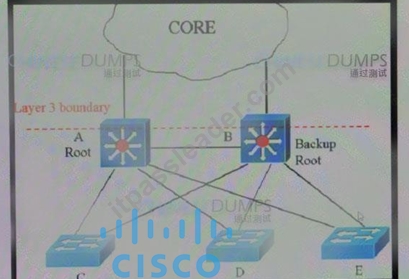
This network is running legacy STP 802.1 d. Assuming "hello_timer" is fixed to 2 seconds, which parameters can be modified to speed up convergence times after single link/node failure?
- A. Only the maximum_transmission_halt_delay and diameter parameters are configurable parameters in 802. to speed up STP convergence process
- B. The transit_delay=5 and dpdu_delay=20 are recommended values, considering helto_timer=2 and specified
- C. Only the transit_delay and bpdu_delay timers are configurable parameters in 802.1d to speed up STP convergence process.
- D. The max_age and forward delay parameters can be adjusted to speed up STP convergence process.
Answer: D
NEW QUESTION # 264
As a network designer, you need to support an enterprise with hundreds of remote sites connected over a single WAN network that carries different types of traffic, including VoIP, video, and data applications.
Which of the following design considerations will not impact design decision?
- A. What direction the data or flows should be metered
- B. Identify traffic types and top talkers over this link
- C. The location of the data collection
- D. Focus on the solution instead of the problem, which helps to reduce downtime duration
Answer: D
Explanation:
* A (Focus on the solution instead of the problem): While resolving issues quickly is important for operations, solution-oriented thinking during the design phase may overlook essential requirements analysis. Design decisions must be based on problem understanding, traffic analysis, and actual network behavior.
Other options explained:
* B, C, D: All directly impact WAN design by influencing QoS, capacity planning, flow optimization, and visibility.
NEW QUESTION # 265
Which two points must network designers consider when designing a new network design or when evaluating an existing network design to help them understand the high-level design direction with regards to the security aspects? (Choose two)
- A. Consider for only new network technologies and components
- B. Consider organization's security policy standards
- C. Consider for only multi-site networks
- D. Consider Business objectives and goals
Answer: B,D
NEW QUESTION # 266
A network architect in an enterprise is designing a network policy for certain database applications. The goal of the policy is to allow these applications to access the internet directly, whereas other user and network applications that communicate with systems or users outside their own network must be routed through the data center. The focus is on achieving higher availability and a better user experience for the database applications, but switching between different network paths based on performance characteristics must be supported.
Which solution meets these requirements?
- A. MPLS L3VPN with QoS
- B. MPLS direct connect
- C. Cloud onRamp for IaaS
- D. Cloud onRamp for SaaS
Answer: D
NEW QUESTION # 267
When consumers that leverage IaaS reach 100% resource capacity, what can be used to redirect the overflow of traffic to the public cloud so there is no disruption to service?
- A. Cloud policing
- B. Cloud bursting
- C. Cloud shaping
- D. Cloud spill
Answer: B
Explanation:
Cloud Bursting is the process by which applications or workloads that run in a private cloud or data center environment are "bursted" into a public cloud infrastructure during high-demand periods. This prevents service degradation and ensures performance continuity without manual intervention.
In CCDE design strategy terms, this enables:
* Elastic scalability
* Cost-effective use of public infrastructure on-demand
* Seamless service delivery to end users
Options like "cloud policing" and "cloud shaping" are not standard terms, and "cloud spill" is not an established mechanism. "Cloud bursting" is the correct architectural mechanism that addresses this overflow requirement.
NEW QUESTION # 268
Company XYZ uses an office model where the employees can use any open desk and plug their laptops in.
They want to authenticate the end users using their domain username and password before allowing them access to the network. The design must also accommodate the ability of controlling traffic within the same group or subnet if a macro (or micro) segmentation-based model is adopted in the future. Which protocol can be recommended for this design to authenticate end users?
- A. RADIUS
- B. EAP
- C. TACACS+
- D. LDAP
Answer: A
Explanation:
https://www.networkstraining.com/what-is-cisco-ise/
NEW QUESTION # 269
Drag and drop the correct mitigation methods from the left onto the corresponding types of attack on the right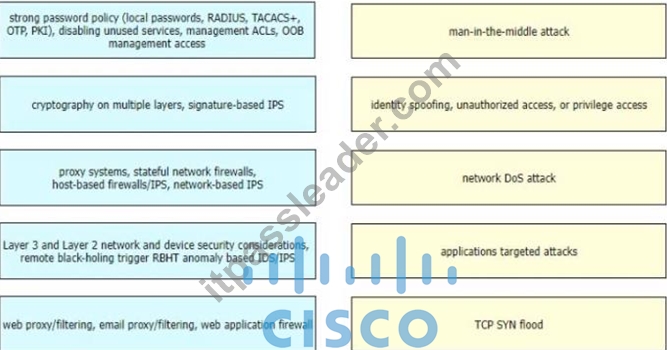
Answer:
Explanation: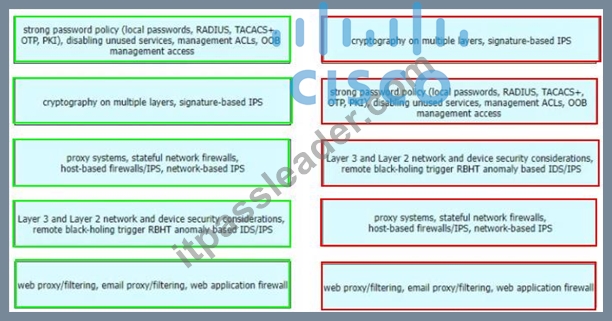
NEW QUESTION # 270
A multicast network is using Bidirectional PIM. Which two combined actions achieve high availability so that two RPs within the same network can act in a redundant manner? (Choose two)
- A. Manipulate the administration distance of the unicast routes to the two RPs
- B. Use two phantom RP addresses
- C. Advertise the two RP addresses in the routing protocol
- D. Use anycast RP based on MSDP peering between the two RPs
- E. Control routing to the two RPs through a longest match prefix
- F. Manipulate the multicast routing table by creating static mroutes to the two RPs
Answer: B,E
Explanation:
InBidirectional PIM, redundancy for Rendezvous Points (RPs) is provided through thePhantom RP mechanism. This setup offers HA by:
* A. Using two phantom RP addresses: You configure two RPs with the same virtual RP address but advertise them with loopback interfaces having different subnet masks. These phantom RPs allow seamless failover between active and standby RPsdatatracker.ietf.org+14arubanetworking.hpe.
com+14examtopics.com+14ciscolive.com+3examtopics.com+3ccie-sp.gitbook.io+3learnwithsalman.
com+4lostintransit.se+4learningnetwork.cisco.com+4.
* F. Controlling routing through a longest match prefix: The active RP is chosen based on unicast routing - the loopback with the longest prefix match to the RP address is preferred. If that RP fails, the IGP converges and the standby with the next-longest prefix becomes activearubanetworking.hpe.com.
This combined mechanism aligns with CCDE v3.1 design principles by ensuring multicast HA with minimal complexity - no MSDP involvement and leveraging existing IGP behaviors.
Why other options are incorrect:
* B&D: Changing administrative distance or protocol advertisement doesn't inherently establish redundancy in Bidir-PIM RP selection.
* C: Static mroutes are static and don't support dynamic redundancy or failover.
* E: Anycast RP with MSDP is not supported or needed in Bidir-PIM environments.
This design ensures robust, seamless RP redundancy using phantom RPs with longest-prefix selection logic, remaining cost-effective and operationally concise.
https://community.cisco.com/t5/networking-knowledge-base/rp-redundancy-with-pim-bidir-phantom-rp/ta-p
/3117191
NEW QUESTION # 271
A customer asks you to perform a high level review of their upcoming WAN refresh for remote sites The review is specially focused on their retail store operations consisting of 500+ locations connected via mutlipoint IPsec VPN solution. Which routing protocol would be valid but would also be the most restrictive for the expansion of this deployment model?
- A. EIGRP
- B. BGP
- C. OSPF
- D. IS-IS
Answer: D
NEW QUESTION # 272
You have been tasked with designing a data center interconnect as part of business continuity You want to use FCoE over this DCI to support synchronous replication. Which two technologies allow for FCoE via lossless Ethernet or data center bridging? (Choose two.)
- A. SONET/SDH
- B. EoMPLS
- C. DWDM
- D. VPLS
- E. Multichassis EtherChannel over Pseudowire
Answer: A,C
NEW QUESTION # 273
Which issue poses a challenge for security architects who want end-to-end visibility of their networks?
- A. An overabundance of manual processes
- B. Too many disparate solutions and technology silos
- C. A network security skills shortage
- D. Too many overlapping controls
Answer: B
Explanation:
End-to-end network visibility is often hindered by:
* Siloed monitoring and logging systems
* Vendor-specific platforms that don't integrate
* Inconsistent telemetry across domains (e.g., WAN, DC, Cloud)
Too many disparate solutions lead to data fragmentation, blind spots, and lack of unified analytics. This makes correlating threats and verifying policy enforcement complex. Overlapping controls (A) and manual processes (C) are operational concerns but don't directly obstruct architectural visibility.
The CCDE blueprint emphasizes cross-domain visibility, consistent policy enforcement, and integration as central to a secure and scalable network design.
NEW QUESTION # 274
Drag and Drop Question
Data residency and sovereignty requirements are based on regional and industry-specific regulations, and different organizations have different data sovereignty requirements.
Implementation of a mechanism that provides control over all access to data by cloud providers and the ability to inspect changes to cloud infrastructure and services is required. Drag and drop the descriptions from the left onto the corresponding categories on the right in no particular order.
Not all options are used.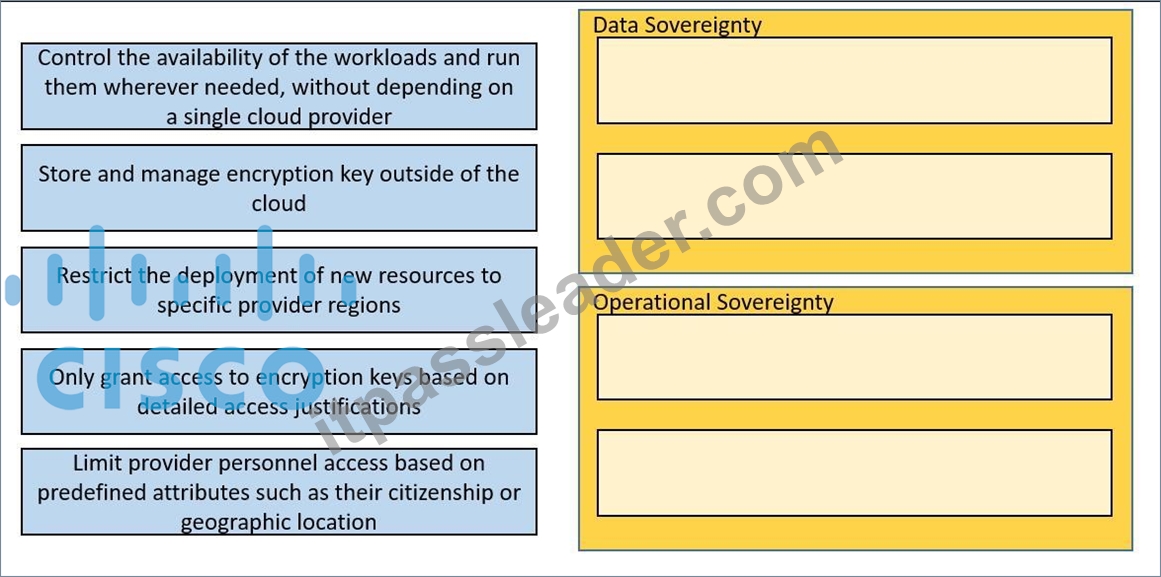
Answer:
Explanation: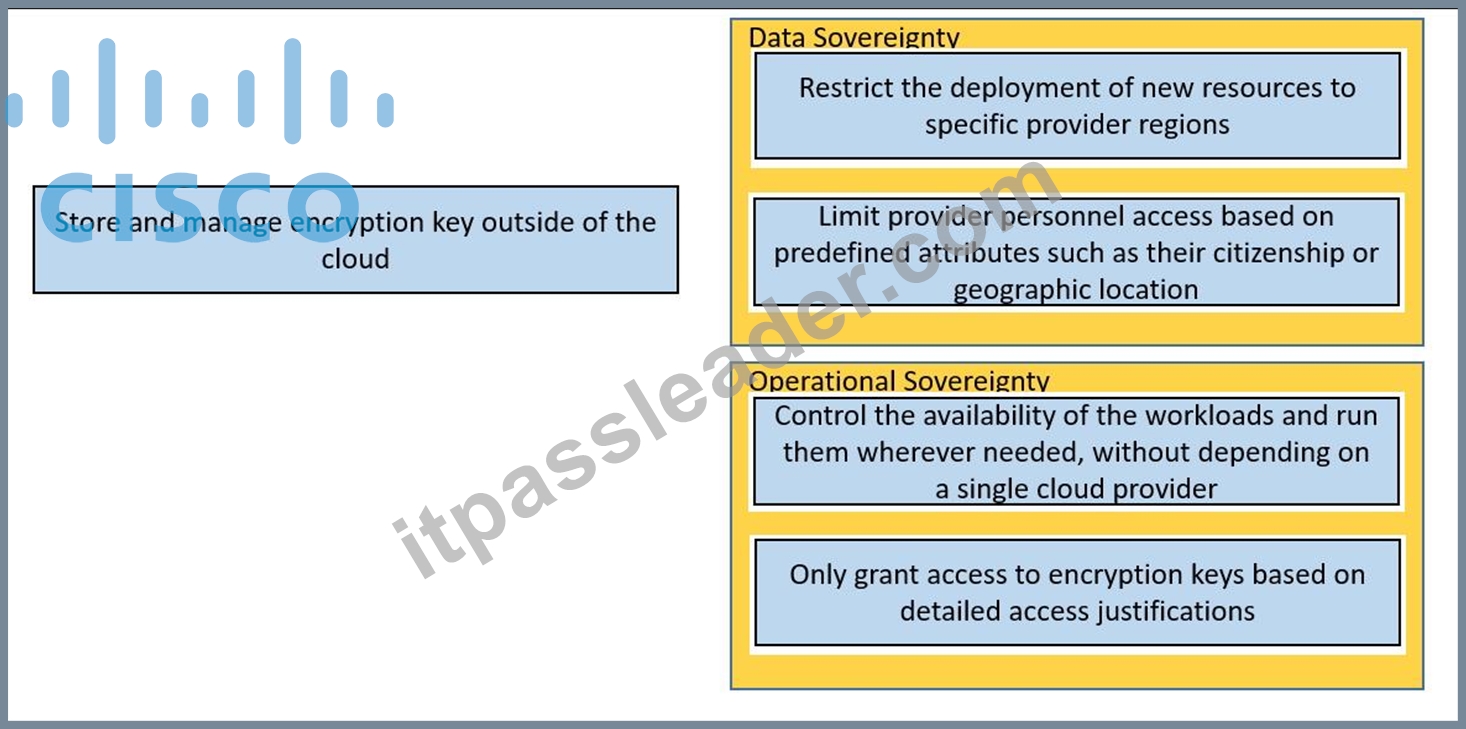
NEW QUESTION # 275
A large enterprise is planning a new WAN connection to headquarters. The current dual-homed setup with static routing is not providing consistent resiliency. Users complain when one specific link fails, while failure of the other causes no issues. The organization wants to improve resiliency and ROI.
Which solution should be recommended?
- A. Procure additional bandwidth
- B. Add an additional link to the WAN
- C. Use dynamic routing toward the WAN
- D. Implement granular quality of service on the links
Answer: C
Explanation:
Comprehensive and Detailed Explanation:
* C: Using dynamic routing protocols (e.g., OSPF, EIGRP, or BGP) provides real-time path selection, automatic failover, and improved resiliency. It eliminates manual reconfiguration delays associated with static routing, directly addressing user experience issues during failure.
Other options:
* A: QoS improves traffic prioritization, not failover/resiliency.
* B: Bandwidth upgrades do not address the failure-handling problem.
* D: Adding a third link increases cost without solving the root issue-ineffective routing response.
NEW QUESTION # 276
Which two actions must be taken when assessing an existing wireless network implementation for its readiness to support voice traffic? (Choose two.)
- A. Check for latency over wireless.
- B. Identify frequent TX power changes.
- C. Check for high channel utilization.
- D. Check for high roaming delay.
- E. Check for uniform radio coverage across the floors.
Answer: C,D
Explanation:
https://community.cisco.com/t5/wireless/channel-utilization/td-p/2716667
NEW QUESTION # 277
Refer to the diagram.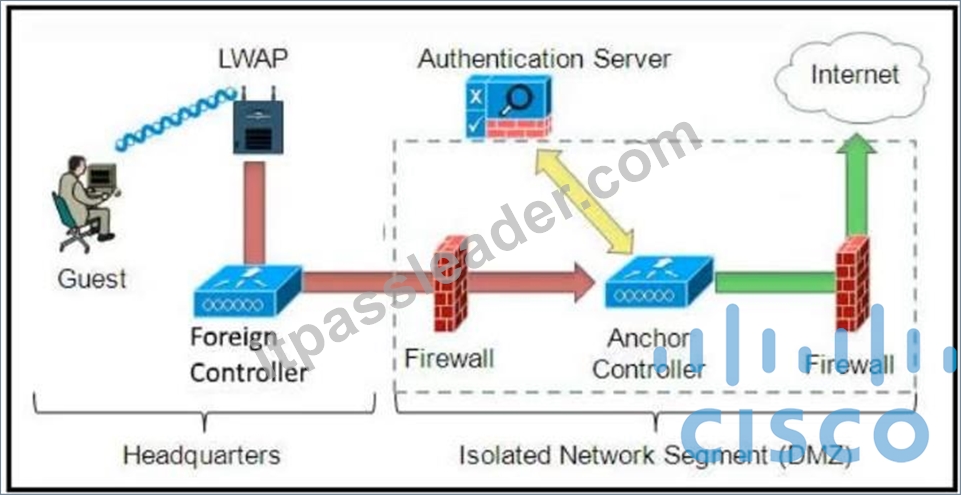
Which solution must be used to send traffic from the foreign wireless LAN controller to the anchor wireless LAN controller?
- A. Encapsulate packets into an EoIP tunnel and send them to the anchor controller.
- B. Send packets from the foreign controller to the anchor controller via IPinIP or IPsec tunnel.
- C. Send packets without encapsulation to the anchor controller over the routed network.
- D. Send packets from the foreign controller to the anchor controller via Layer 3 MPLS VPN or VRF-Lite
Answer: D
Explanation:
* In Cisco Wireless Guest Anchor deployments, traffic between foreign and anchor controllers is typically tunneled using CAPWAP (Control and Provisioning of Wireless Access Points).
* The CAPWAP tunnel operates over IP and can traverse MPLS VPN or VRF-Lite Layer 3 segmentation to maintain logical separation across different segments or geographic sites.
* This allows end-to-end isolation of guest traffic from the enterprise network into the DMZ anchor location, as shown in the diagram.
Why other options are incorrect:
* B: Unencapsulated traffic would expose guest traffic inside the enterprise network.
* C: EoIP is not a standard Cisco wireless tunneling method.
* D: IPinIP or IPsec tunnels are not typically used between WLCs for guest anchor tunneling.
NEW QUESTION # 278
A company plans to use BFD between its routers to detect a connectivity problem inside the switched network. An IPS is transparently installed between the switches. Which packets should the IPS forward for BFD to work under all circumstances?
- A. Fragmented packet with the do-not-fragment bit set
- B. IP packets with the destination IP address 0.0.0.0.
- C. IP packet with the multicast IP destination address
- D. IP packets with identical source and destination IP addresses
- E. IP packets with the multicast IP source address
- F. IP packets with broadcast IP source addresses
Answer: D
Explanation:
BFD (Bidirectional Forwarding Detection) operates by exchanging control packets between peers, typically using UDP encapsulation. In single-hop deployments, BFD sessions are often established using:
* Source IP = destination IP = local interface IP (identical source and destination addresses), especially in certain implementations like Cisco single-hop BFD.
* This allows rapid fault detection without routing dependency.
The IPS must permit these packets to avoid disrupting BFD functionality.
Why other options are incorrect:
* A: Fragmentation is irrelevant to BFD.
* B, C, D, F: BFD does not use broadcast, multicast, or 0.0.0.0 addresses.
-
NEW QUESTION # 279
Which two data plane hardening techniques are true? (Choose two)
- A. disable unused services
- B. warning banners
- C. infrastructure ACLs
- D. redundant AAA servers
- E. Control Plane Policing
- F. routing protocol authentication
- G. SNMPv3
Answer: A,C
NEW QUESTION # 280
Which two mechanisms avoid suboptimal routing in a network with dynamic mutual redistribution between multiple OSPFv2 and EIGRP boundaries? (Choose two.)
- A. route filtering
- B. route tagging
- C. AD manipulation
- D. matching EIGRP process ID
- E. matching OSPF external routes
Answer: A,B
NEW QUESTION # 281
A senior network designer suggests that you should improve network convergence times by reducing BGP timers between your CE router and the PE router of the service provider. Which two factors should you consider to adjust the timer values? (Choose two.)
- A. service provider scheduling of changes to the PE
- B. manual updates to the peer groups
- C. service provider agreement to support tuned timers
- D. number of VRFs on the PE router
- E. number of routes on the CE router
Answer: C,E
NEW QUESTION # 282
You are tasked with the design of a high available network. Which two features provide fail closed environments? (Choose two.)
- A. MST
- B. L2MP
- C. EIGRP
- D. RPVST+
Answer: A,D
Explanation:
* B (RPVST+ - Rapid Per VLAN Spanning Tree Plus): Provides fast convergence while blocking redundant paths to prevent loops - fail closed behavior under failure scenarios.
* C (MST - Multiple Spanning Tree): Provides loop prevention and isolates failures to specific instances (VLANs), maintaining fail closed protection.
Why other options are incorrect:
* A: EIGRP is a routing protocol; does not operate at Layer 2 to provide fail-closed loop protection.
* D: L2MP (Layer 2 Multipathing) allows multiple active links but requires additional loop prevention mechanisms.
-
NEW QUESTION # 283
What is a disadvantage of the traditional three-tier architecture model when east-west traffic between different pods must go through the distribution and core layers?
- A. Low bandwidth
- B. High latency
- C. Scalability
- D. Security
Answer: B
Explanation:
* D (High latency):In three-tier architectures, east-west traffic between different pods (access domains) must traverse additional layers (distribution and core), introducing extra hops and thus adding latency.
This inefficiency is one reason why spine-leaf architectures are favored for modern data centers.
Other options explained:
* A: Bandwidth is less of a concern with high-speed core links.
* B: Security is not directly affected by east-west traversal in this architecture.
* C: Scalability is limited, but the primary issue for east-west traffic is latency.
NEW QUESTION # 284
......
Earning a Cisco Certified Design Expert certification is a significant achievement for any network engineer, architect, or designer. It demonstrates that the candidate possesses the skills and knowledge required to design and implement complex network solutions, as well as a comprehensive understanding of network design principles and best practices. The Cisco 400-007 exam is a critical step in achieving this certification and is an excellent opportunity for professionals to validate their skills and knowledge in network design.
400-007 Dumps - Pass Your Certification Exam: https://exam-labs.itpassleader.com/Cisco/400-007-dumps-pass-exam.html