

[2026] Practice with these C_ABAPD_2507 dumps Certification Sample Questions
Get Instant Access of 100% REAL C_ABAPD_2507 DUMP Pass Your Exam Easily
SAP C_ABAPD_2507 Exam Syllabus Topics:
| Topic | Details |
|---|---|
| Topic 1 |
|
| Topic 2 |
|
| Topic 3 |
|
| Topic 4 |
|
NEW QUESTION # 12
What is a class defined as part of an ABAP program called?
- A. Local variable
- B. Global variable
- C. Global class
- D. Local class
Answer: D
NEW QUESTION # 13
When you work with a test class, you can set up some prerequisites before the actual testing.
In which sequence will the following fixtures be called by the test environment?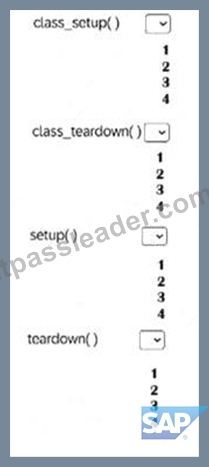
Answer:
Explanation: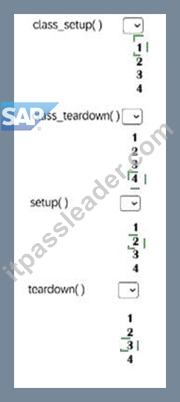
Explanation:
class_setup( )
setup( )
teardown( )
class_teardown( )
ABAP Unit Test framework defines a fixed sequence for test fixture methods to ensure reliable test execution and cleanup:
* class_setup( ):Called once before any tests in the test class are run. Used to prepare global test data or setup that applies to all tests.
* setup( ):Called before each individual test method to prepare local test data or preconditions.
* teardown( ):Called after each individual test method to clean up what was done in setup( ).
* class_teardown( ):Called once after all tests have been executed to clean up class-level resources.
This sequence supports isolation and repeatability of test executions, ensuring that one test's result does not influence another's.
Reference: ABAP Unit Test Framework Documentation, ABAP Cloud Programming Model Guidelines - Test Class Lifecycle Management.
NEW QUESTION # 14
In class ZCL_CLASS_A, you use the statement DATA var TYPE ***
What may stand in place of ***?
Note: There are 2 correct answers to this question.
- A. The name of a domain from the ABAP Dictionary
- B. The name of a type defined privately in class ZCL_CLASS_A
- C. The name of a type defined privately in another class
- D. The name of a data element from the ABAP Dictionary
Answer: B,D
NEW QUESTION # 15
Which of the following rules apply for dividing with ABAP SQL?
Note: There are 3 correct answers to this question.
- A. Numeric function division( numerator, denominator, decimal places ) accepts floating point input.
- B. Numeric function division( numerator, denominator, decimal places ) accepts decimal input.
- C. The division operator "/" accepts decimal input.
- D. Numeric function div( numerator, denominator ) expects only integer input.
- E. The division operator "/" accepts floating point input.
Answer: A,B,D
Explanation:
Comprehensive and Detailed Explanation From Exact Extract:
In ABAP SQL, the handling of arithmetic operations - especially division - is handled with care for data types and precision. Here's how each applies:
* B. Numeric function division(numerator, denominator, decimal places) accepts decimal inputThis is correct. The division function is designed for decimal-based calculations, where precision control is needed via the third parameter (number of decimal places). It supports packed numbers (DEC).
* C. Numeric function div(numerator, denominator) expects only integer inputThis is correct. The div function is an integer division operator, returning an integer result and only accepts integers as input types.
* E. Numeric function division(numerator, denominator, decimal places) accepts floating point inputThis is correct. In addition to decimals, division() can also work with floating point types (FLTP), enabling flexible division where decimals are not sufficient.
* A. The division operator "/" accepts decimal inputThis is incorrect in the context of ABAP SQL.
The / operator is not available as a built-in operator in Open SQL; arithmetic operations like this are not supported with native operators - only via functions.
* D. The division operator "/" accepts floating point inputAgain, this is incorrect, as / is not valid syntax in ABAP SQL queries. Only built-in functions like div or division are supported in the CDS/Open SQL layer.
Reference:ABAP CDS Development Guide, section 2.2 - Built-in functions in ABAP SQL and CDS expressions for numerical calculations, specifically division() and div().
NEW QUESTION # 16
What describes multi-column internal tables?
- A. They use one complete data type.
- B. They must contain nested components.
- C. They are based on a structured row type.
- D. They use one incomplete data type.
Answer: C
NEW QUESTION # 17
Given the following code which defines an SAP HANA database table in SAP S/4HANA Cloud, public edition: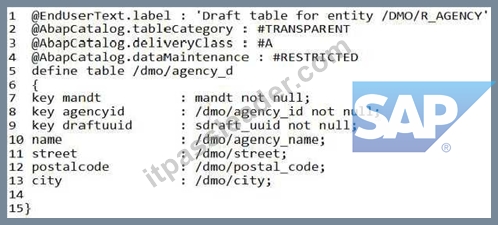
You are a consultant and the client wants you to extend this SAP database table with a new field called "zz_countrycode" on line. Which of the following is the correct response?
- A. The database table can be extended once it has been extensibility enabled by the customer.
- B. The database table cannot be extended since it has not been extensibility enabled by SAP.
- C. The database table can be extended whether extensibility enabled or not if it is assigned to a software component of type "ABAP Cloud".
- D. The database table can be extended whether extensibility enabled or not if it is assigned to a software component of type "Standard ABAP".
Answer: C
NEW QUESTION # 18
Given the following code,
DATA gv_text1 TYPE string. "#EC_NEEDED
DATA gv_text2 TYPE string ##NEEDED.
What are valid statements? Note: There are 2 correct answers to this question.
- A. The pseudo-comment is checked by the syntax checker.
- B. The pragma is not checked by the syntax checker.
- C. #EC_NEEDED is not checke d by the syntax checker.
- D. ##NEEDED is checked by the syntax checker.
Answer: C,D
NEW QUESTION # 19
Which of the following is a generic internal table type?
- A. STANDARD TABLE
- B. HASHED TABLE
- C. INDEX TABLE
- D. SORTED TABLE
Answer: C
Explanation:
A generic internal table type is a table type that does not define all the attributes of an internal table in the ABAP Dictionary; it leaves some of these attributes undefined. A table type is generic in the following cases1:
You have selected Index Table or Not Specified as the access type.
You have not specified a table key or specified an incomplete table key.
You have specified a generic secondary table key.
A generic table type can be used only for typing formal parameters or field symbols. A generic table type cannot be used for defining data objects or constants2.
Therefore, the correct answer is B. INDEX TABLE, which is a generic table type that does not specify the access type or the table key. The other options are not generic table types, because:
A . SORTED TABLE is a table type that specifies the access type as sorted and the table key as a unique or non-unique primary key3.
C . STANDARD TABLE is a table type that specifies the access type as standard and the table key as a non-unique standard key that consists of all the fields of the table row in the order in which they are defined4.
D . HASHED TABLE is a table type that specifies the access type as hashed and the table key as a unique primary key5.
NEW QUESTION # 20
/DMO/I_Connection is a CDS view.
What variable type is connection full based on the following code? DATA connection full TYPE
/DMD/I_Connection.
- A. Simple variable
- B. Internal Table
- C. Structure
Answer: C
Explanation:
Based on the following code, the variable type of connection_full is a structure. A structure is a complex data type that consists of a group of related data objects, called components, that have their own data types and names. A structure can be defined using the TYPES statement or based on an existing structure type, such as a CDS view entity or a CDS DDIC-based view. In this case, the variable connection_full is declared using the TYPE addition, which means that it has the same structure type as the CDS view entity /DMO/I_Connection. The CDS view entity /DMO/I_Connection is a data model view that defines a data model based on the database table /DMO/Connection. The CDS view entity /DMO/I_Connection has the following components: carrid, connid, airpfrom, airpto, distance, and fltime. Therefore, the variable connection_full has the same components as the CDS view entity /DMO/I_Connection, and each component has the same data type and length as the corresponding field in the database table /DMO/Connection.
NEW QUESTION # 21
Which function call produces the string 'LORE IPSUM FACTUM'?
- A. from_mixed( val = 'LoreIpsumFactum' sep=
- B. condense to_upper('LoreIpsumFactum' ) )
- C. to mixed(val = 'Lore IpsumFactum' sep=
- D. to_upper( condense( 'Lore IpsumFactum' ) )
Answer: D
NEW QUESTION # 22
In a subclass sub1, you want to redefine a component of a superclass super1.
How do you achieve this?
Note: There are 2 correct answers to this question.
- A. You implement the redefined component in sub1.
- B. You add the clause REDEFINITION to the component in sub1.
- C. You add the clause REDEFINITION to the component in super1.
- D. You implement the redefined component for a second time in super1.
Answer: A,B
Explanation:
Comprehensive and Detailed Explanation From Exact Extract:
To redefine a component in a subclass:
* The component (method) in the superclass must be defined with the FOR REDEFINITION addition.
* In the subclass, you use the REDEFINITION clause in the method declaration and implement the method in the subclass to override the superclass behavior.
Thus:
* Option A is correct because the method declaration in sub1 must include the REDEFINITION addition.
* Option D is correct because the actual redefined method implementation must be provided in the subclass sub1.
* Option B is incorrect because the component is not re-implemented in the superclass.
* Option C is incorrect because REDEFINITION is not added in the superclass, but FOR REDEFINITION is.
Reference: SAP Help 2, section on object-oriented ABAP programming with class-based components and redefinitions in inheritance structures.
NEW QUESTION # 23
In ABAP SQL, which of the following retrieves the association field_Airline-Name of a CDS view?
- A. \_Airline-Name
- B. "_Airline Name
- C. /_Airline Name
- D. @_Airline-Name
Answer: D
Explanation:
In ABAP SQL, the syntax to retrieve the association field of a CDS view is to use the @ sign followed by the association name and the field name, separated by a period sign (.). For example, to retrieve the association field _Airline-Name of a CDS view, the syntax is @_Airline.Name. This syntax allows the access to the fields of the target data source of the association without explicitly joining the data sources1. The other options are incorrect because they use the wrong symbols or formats to access the association field.
NEW QUESTION # 24
What are some features of a unique secondary key? Note: There are 2 correct answers to this question.
- A. It is created when a table is filled.
- B. It is updated when the table is modified.
- C. It is updated when the modified table is read again.
- D. It is created with the first read access of a table.
Answer: B,D
Explanation:
A unique secondary key is a type of secondary key that ensures that the key combination of all the rows in a table is unique. A unique secondary key has two purposes: firstly, to speed up access to the table, and secondly, to enforce data integrity1.
It is created with the first read access of a table: This is true. A unique secondary key is created when an internal table is filled for the first time using the statement READ TABLE or a similar statement. The system assigns a name and an index to each row of the table based on the key fields23.
It is updated when the modified table is read again: This is false. A unique secondary key does not need to be updated when the internal table content changes, because it already ensures data uniqueness. The system uses a lazy update strategy for non-unique secondary keys, which means that it delays updating them until they are actually accessed23.
You cannot do any of the following:
It is created when a table is filled: This is false. As explained above, a unique secondary key is created only with the first read access of a table23.
It is updated when the modified table is read again: This is false. As explained above, a unique secondary key does not need to be updated when the internal table content changes23.
NEW QUESTION # 25
What RESTful Application Programming feature is used to ensure the uniqueness of a semantic key?
- A. Validation
- B. Determination
- C. Action
Answer: B
Explanation:
The RESTful Application Programming feature that is used to ensure the uniqueness of a semantic key is determination. A determination is a type of behavior implementation that defines a logic that is executed automatically when certain events occur, such as create, update, delete, or activate. A determination can be used to calculate or derive values for certain fields, such as semantic keys, based on other fields or external sources. A determination can also be used to check the uniqueness of a semantic key by comparing it with the existing values in the database or the transaction buffer. A determination can use the ABAP SQL or the EML syntax to access and manipulate data. A determination can be defined using the DETERMINE action clause in the behavior definition of a CDS view entity or a projection view. A determination can also be annotated with the @ObjectModel.determination annotation to specify the event, the timing, and the scope of the determination12 The other RESTful Application Programming features are not used to ensure the uniqueness of a semantic key, but have different purposes and effects. These features are:
Validation: A validation is a type of behavior implementation that defines a logic that is executed automatically when certain events occur, such as create, update, delete, or activate. A validation can be used to check the consistency and correctness of the data, such as mandatory fields, data types, value ranges, or business rules. A validation can use the ABAP SQL or the EML syntax to access and manipulate data. A validation can be defined using the VALIDATE action clause in the behavior definition of a CDS view entity or a projection view. A validation can also be annotated with the @ObjectModel.validation annotation to specify the event, the timing, and the scope of the validation12 Action: An action is a type of behavior implementation that defines a logic that is executed explicitly by the user or the application. An action can be used to perform a specific business operation, such as creating, updating, deleting, or activating an entity instance, or triggering a workflow or a notification. An action can use the ABAP SQL or the EML syntax to access and manipulate data. An action can be defined using the ACTION clause in the behavior definition of a CDS view entity or a projection view. An action can also be annotated with the @ObjectModel.action annotation to specify the name, the description, the parameters, and the visibility of the action12
NEW QUESTION # 26
Given this code,
DATA(structure_variable) REDUCE structure_type (
INIT
h_structure_variable TYPE structur e_type
FOR row IN source_itab
NEXT
h_structure_variable-f1 += row-f1
h_structure_variable-f2+= row-f2
which of the following statements are correct? Note: There are 2 correct answers to this question.
- A. Components of h_structuree_variable will be copied to same-named components of structure_variable.
- B. This REDUCE expression may produce a result of multiple rows.
- C. The REDUCE expression creates a loop over source_itab.
- D. row is a predefined name and cannot be changed.
Answer: A,C
NEW QUESTION # 27
......
Free Exam Files Downloaded Instantly: https://exam-labs.itpassleader.com/SAP/C_ABAPD_2507-dumps-pass-exam.html