

100% Updated EMC D-PST-DY-23 Enterprise PDF Dumps
Use Valid Exam D-PST-DY-23 by ITPassLeader Books For Free Website
EMC D-PST-DY-23 exam is designed for professionals who have a good understanding of data center operations, storage area networks (SAN), and Server Virtualization. D-PST-DY-23 exam tests the candidates' ability to perform the installation, configuration, and management of clustered Dell PowerStore systems using best practices. Other skills required for the exam include the deployment of Dell PowerStore solutions in multi-vendor environments and configuring the Dell PowerStore for Fibre Channel, iSCSI, and NFS/SMB protocols.
NEW QUESTION # 49
SIMULATION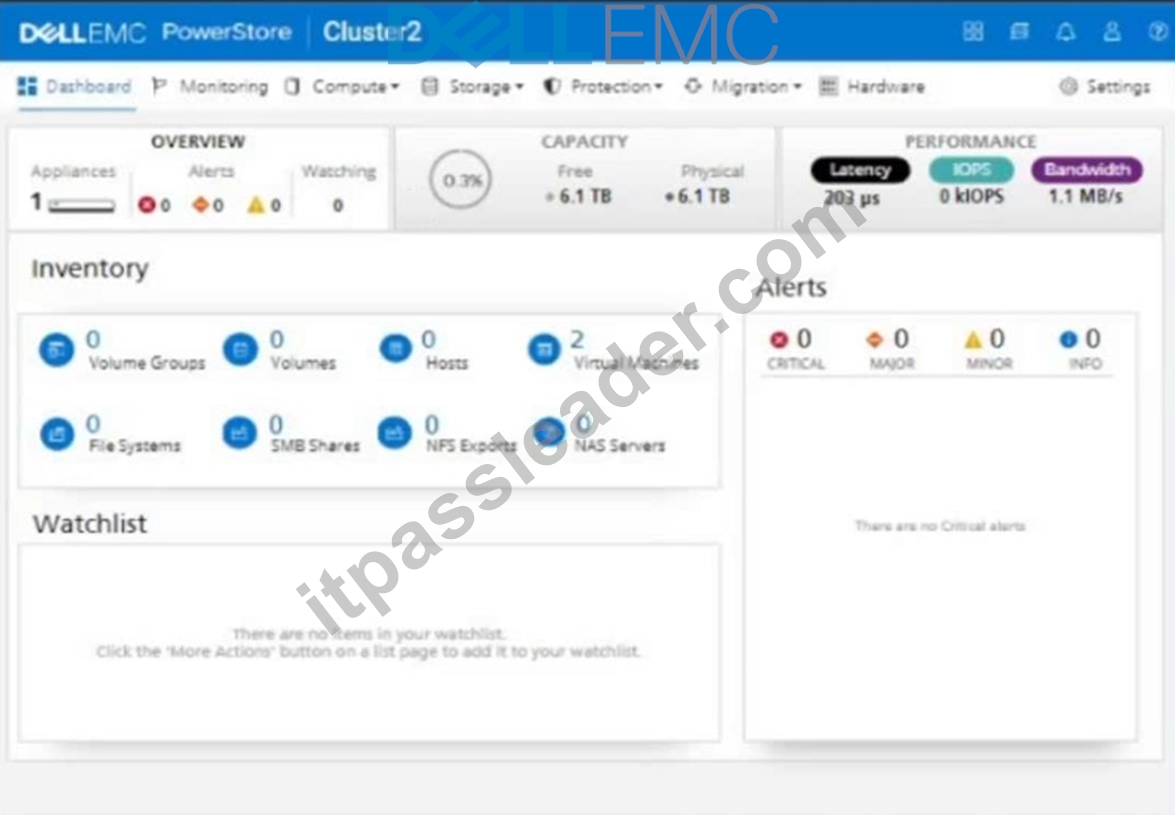
Use the simulator to assign a protection policy to the virtual machine "VM1". Use the following settings:
Snapshots on Monday through Friday at 10:00 PM Eastern Time
Retention of 10 days
When you have finished, continue to the next question.
Answer:
Explanation:
See the Explanation below for complete solution
Explanation:
Navigate to the virtual machine management section where VMs are listed, usually under the "Compute" or "VM" section.
Locate "VM1" from the list of virtual machines.
Access the settings or properties of "VM1".
Look for the "Protection" or "Protection Policies" section within the VM settings.
Select the option to create a new policy or assign an existing one.
In the policy settings, configure the snapshot schedule:
Set the frequency to weekly on Monday, Tuesday, Wednesday, Thursday, and Friday.
Set the time to 10:00 PM Eastern Time.
Configure the retention period for the snapshots to be 10 days.
Save the policy and ensure it is correctly associated with "VM1".
NEW QUESTION # 50
Use the simulator to create a new 100 GB volume. Use a category of Other. Associate the new volume with a protection policy that includes a rule that takes a snapshot every hour Monday-Friday and retains it for 5 days.
When you have finished continue to the next question.
Answer:
Explanation:
See explanation below.
Explanation: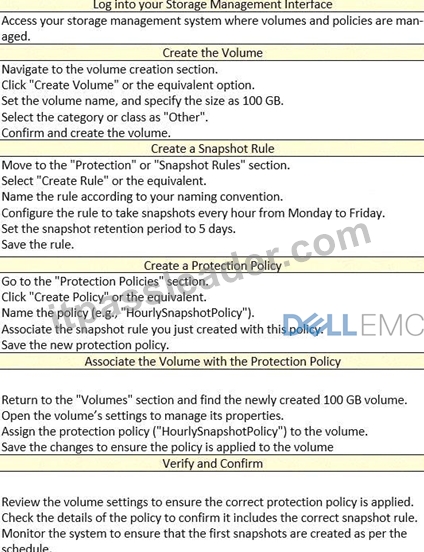
NEW QUESTION # 51
Use the simulator to create an SMB NAS server using the following information:
* NAS and SMB computer name: payrollserver
* Network interface: BaseEnclosure-bond1
* IP address: 192.168.2.20
* Subnet: /24
* Gateway: 192.168.2.254
* VLAN: 1504
* AD/DNS: 192.168.2.50
* Windows domain name: company.com
* Domain administrator credentials: Administrator/password
When you have finished continue to the next question.
Answer:
Explanation:
See the Explanation below for complete solution.
1. Open the simulator and log in with the default credentials: admin/Password123#.
2. SelectStorage>NAS Serversfrom the left menu.
3. Click+ CREATEto launch the Create NAS Server wizard.
4. Enterpayrollserveras the NAS and SMB computer name and clickNext.
5. SelectBaseEnclosure-bond1as the network interface and clickNext.
6. Enter192.168.2.20as the IP address,/24as the subnet,192.168.2.254as the gateway, and1504as the VLAN ID. ClickNext.
7. SelectJoin a Windows domainas the SMB server type and clickNext.
8. Enter192.168.2.50as the AD/DNS server,company.comas the Windows domain name,Administratoras the domain administrator username, andpasswordas the domain administrator password. ClickNext.
9. Review the summary and clickFinishto create the SMB NAS server.
NEW QUESTION # 52
What is the primary goal of the PowerStore Migration feature?
- A. Increasing CPU performance
- B. Automating backup processes
- C. Enabling cloud storage integration
- D. Facilitating the movement of data between storage systems
Answer: D
NEW QUESTION # 53
A Storage Administrator is doing a quarterly space audit on the company's PowerStore T.
The Administrator notices that Vol-SMB004 was accidentally set to 5 TB when it should have been set to 4 TB.
When going to change the size, the system will NOT accept the change.
What is preventing the change?
- A. Volume size cannot be decreased
- B. Volume has snapshots
- C. Storage Administrator does not have permissions to shrink the volume
- D. There is an active minor alert on the volume
Answer: A
NEW QUESTION # 54
A PowerStore X system is being implemented using Dell EMC S5248F-ON Ethernet switching as data switches.
What is required when configuring the VLT interconnects on the data switches?
- A. Assign the switch default route for the VLT traffic
- B. On each switch, select the switch management port MAC as the VLT MAC
- C. Set the VLT connection to the switch default VLAN
- D. Configure the VLT MACs with a matching unique made-up address
Answer: D
NEW QUESTION # 55
Which network topology is commonly used for connecting PowerStore nodes and switches?
- A. Bus topology
- B. Ring topology
- C. Star topology
- D. Mesh topology
Answer: C
NEW QUESTION # 56
Refer to the Exhibit.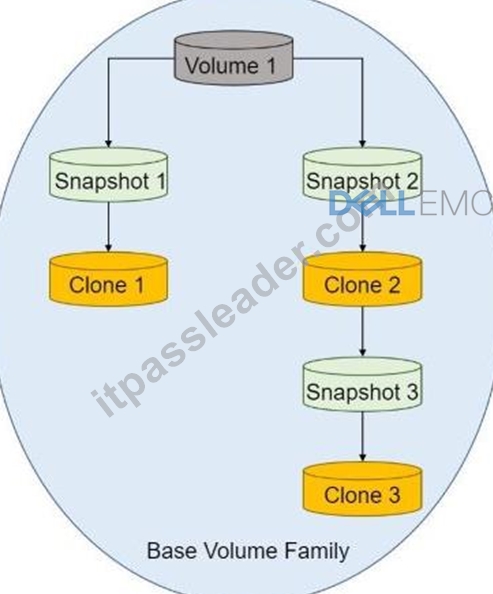
What is the base resource for Thin Clone 3?
- A. Volume 1
- B. Snapshot 2
- C. Thin Clone 2
- D. Snapshot 3
Answer: A
NEW QUESTION # 57
A PowerStore T administrator discovers that only one port on each node is active and passing traffic. The other port is healthy and online, but total bandwidth is only half of what the customer expects.
Which action could resolve the issue?
- A. Implement Dynamic Link Aggregation Group
- B. Implement VLT and Dynamic Link Aggregation Group
- C. Configure Link Aggregation Control Protocol and Dynamic Link Aggregation Group
- D. Configure VLT and Link Aggregation Control Protocol
Answer: D
NEW QUESTION # 58
An administrator is asked to protect a virtual machine using a protection policy.
Which statement is correct?
- A. The policy protects the underlying file systems and replication is supported.
- B. The policy protects the underlying file systems and replication is not supported.
- C. The policy protects the underlying vVols and replication is supported.
- D. The policy protects the underlying vVols and replication is not supported.
Answer: D
NEW QUESTION # 59
Place the steps in order for configuring source and destination vCenters when setting up a vVol replication with SRM.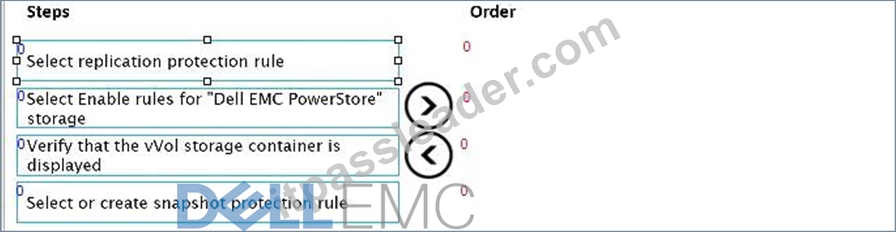
Answer:
Explanation: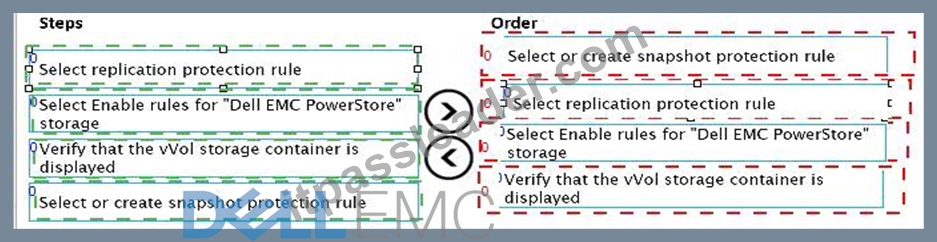
Explanation: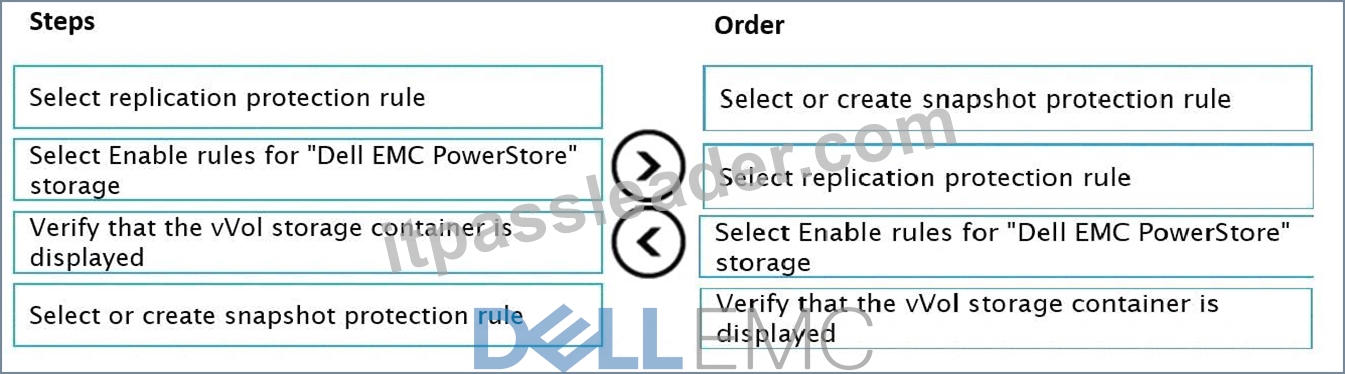
NEW QUESTION # 60
Refer to the exhibit.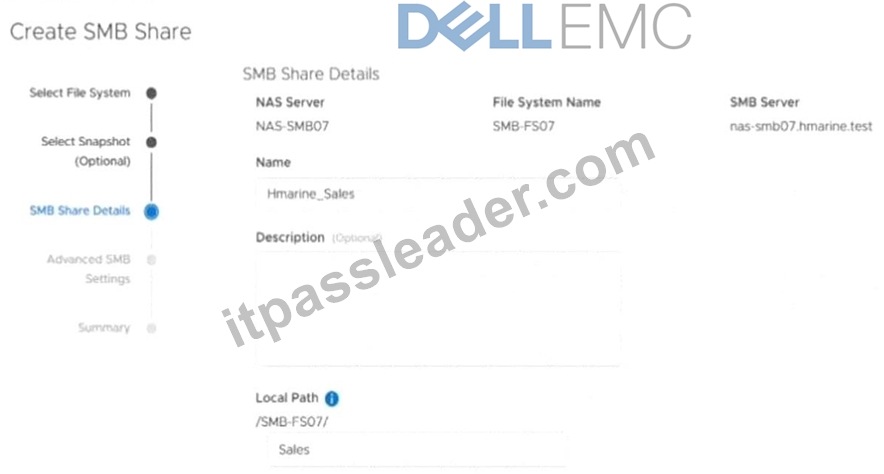
Which SMB path is used to access the share from client side?
- A. \\SMB-FS07\Hmarine_Sales
- B. \\SMB-FS07\Sales\Hmarine_Sales
- C. \\nas-smb07.hmarine test\SMB-FS07\ Hmarine_Sales
- D. \\nas-smb07.hmarine.test\ Hmarine_Sales
Answer: D
NEW QUESTION # 61
What is the benefit of using host groups in PowerStore for managing access to storage resources?
- A. Simplifying network configuration
- B. Streamlining hardware maintenance
- C. Reducing the need for backups
- D. Improving cooling efficiency
Answer: A
NEW QUESTION # 62
What are two supported combinations of source and destination vVol Storage Containers when replicating Resource Groups on PowerStore? (Choose two.)
- A. One-to-many replication volumes from one source PowerStore to multiple destination PowerStore appliances.
- B. Cascade replication to three different sites.
- C. Multiple replications in different directions.
- D. One-to-one replication arouofrom source storage container to destination storage container.
Answer: C,D
Explanation:
PowerStore supports a straightforward one-to-one relationship where a resource group in a source storage container is replicated to a destination storage container. This is the most common and simplest replication setup.
NEW QUESTION # 63
What is the default file snapshot access type in PowerStore?
- A. Snapshot (Read/Write)
- B. Protocol (Read/Write)
- C. Protocol (Read-Only)
- D. Snapshot (Read-Only)
Answer: C
NEW QUESTION # 64
What is the primary purpose of remote protection in PowerStore?
- A. Replicating data to a remote site for disaster recovery
- B. Improving network connectivity
- C. Enhancing CPU performance
- D. Increasing local storage capacity
Answer: A
NEW QUESTION # 65
Which network does the PowerStore Discovery Utility use to identify unconfigured appliances?
- A. Internal
- B. Management
- C. ICM
- D. IDN
Answer: B
Explanation:
PowerStore Discovery Utility and Network Usage
The PowerStore Discovery Utility is a tool used to find and initially configure unconfigured PowerStore appliances on the network. It uses the Management Network to perform this discovery.
Here's how it works:
mDNS (Multicast DNS): The utility relies on mDNS, a protocol that allows devices to discover each other on a local network without a pre-configured DNS server. This is essential for finding new PowerStore appliances that haven't been set up yet.
Management Network: The Management Network in PowerStore is dedicated to out-of-band management. It's the network used for:
Initial appliance discovery
Accessing the PowerStore Manager interface
Performing management tasks
Port 5353: Both TCP and UDP port 5353 must be open on the Management Network for mDNS to function correctly and allow the discovery utility to find the unconfigured appliances.
Why other options are incorrect:
A . IDN: IDN (Internal Dell Network) is not a standard term related to PowerStore discovery.
C . ICM: ICM (Internet Control Message Protocol) is a network protocol used for error reporting and diagnostics, not for device discovery.
D . Internal: While the term "Internal" might seem relevant, it's not specific enough. The Management Network is the precise network used for this purpose.
Dell PowerStore Reference
PowerStore: Discover and Configure a PowerStore Appliance: This document in the PowerStore documentation explains the process of using the Discovery Utility and mentions that it requires network access to the appliance's management IP address, which is on the Management Network.
NEW QUESTION # 66
A storage administrator with a small budget must deploy a new scalable block-optimized storage solution requiring NVMe-oF without adding a license.
Which PowerStore configuration would meet the requirements?
- A. 500 X with one expansion enclosure
- B. 500 T with no expansion enclosure
- C. 500 T with one expansion enclosure
- D. 500 X with no expansion enclosure
Answer: B
NEW QUESTION # 67
How is the VASA provider registered with vSphere when connecting to a PowerStore X system?
- A. Automatically added during Initial Configuration
- B. Built into the PowerStore X system code
- C. Manually added from vCenter server using add storage provider option
- D. VASA is unsupported in PowerStore X models
Answer: C
NEW QUESTION # 68
Which component in a multi-appliance cluster receives the NDU package and distributes the packages to other appliances?
- A. Master appliance of the cluster
- B. Either node on any appliance
- C. Primary node on any appliance
- D. Peer node on any appliance
Answer: A
NEW QUESTION # 69
What is the main benefit of using the PowerStore Migration feature for data movement?
- A. Automating software updates
- B. Enhancing CPU performance
- C. Minimizing data loss and downtime
- D. Reducing power consumption
Answer: C
NEW QUESTION # 70
In which user interfaces are vVol asynchronous remote replication sessions configured?
- A. VMware vSphere and Powerstore Manager
- B. Powerstore Manager and SRM
- C. SRM and Powerstore Volume Manager
- D. VMware vSphere and SRM
Answer: D
NEW QUESTION # 71
Which type of network is used for storage migration between appliances?
- A. Inter-node network
- B. Storage network
- C. Intra-Cluster Management network
- D. Intra-Cluster Data network
Answer: D
NEW QUESTION # 72
Which drive configuration is available for the PowerStore Expansion Enclosure?
- A. NVMe NVRAM (all slots)
- B. NVMe SCM (all slots)
- C. SAS SSD (all slots)
- D. NVMe SSD (all slots)
Answer: C
NEW QUESTION # 73
Which component is responsible for managing software-defined storage features in PowerStore?
- A. Fiber Channel switches
- B. PowerStore Manager
- C. Storage media
- D. Network interface cards
Answer: B
NEW QUESTION # 74
......
EMC D-PST-DY-23 Official Cert Guide PDF: https://exam-labs.itpassleader.com/EMC/D-PST-DY-23-dumps-pass-exam.html